
Here’s the reality: Google reviews can make or break whether someone even calls your business, visits, or just skips to the next option. In Hyderabad, where there are plenty of choices for almost every service, people compare businesses side by side before deciding.
Actually, just because a review is negative doesn’t mean Google will remove it. The main thing to check is whether it breaks Google’s rules or if it’s just honest feedback from a real customer.
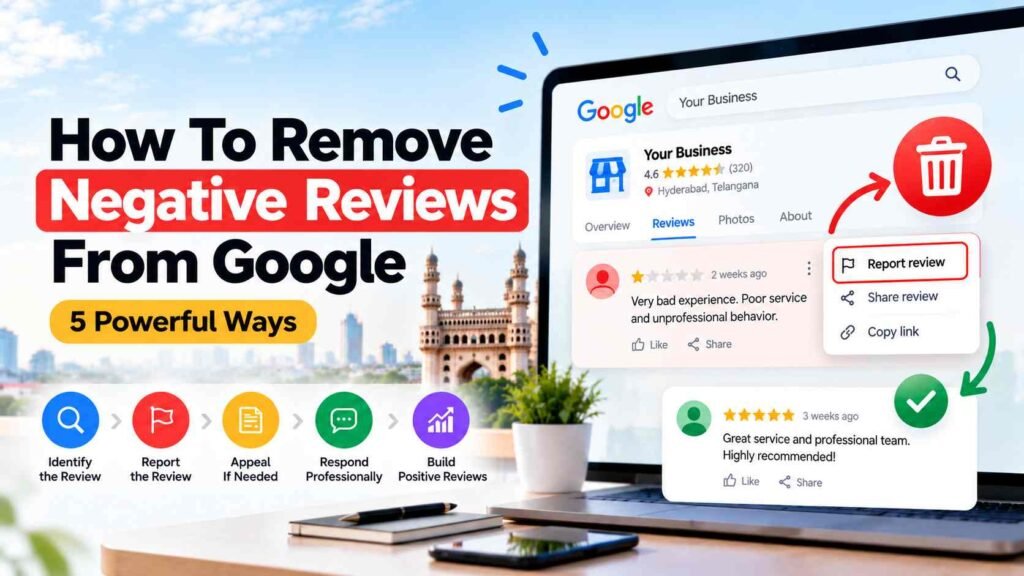
If you’re trying to figure out how to remove negative reviews from Google, start by checking if the review actually breaks any policies. Report the ones that do, use the appeal process if needed, and for genuine criticism, handle it professionally.
I’ll break down five practical ways to deal with negative Google reviews-no shortcuts, no fake reviews, and nothing that could backfire on your reputation.
Why Can Negative Reviews Affect Your Businesses?
Consider a customer searching for a clinic in Banjara Hills, a salon in Kukatpally, a real estate company in Gachibowli, or a restaurant in Jubilee Hills.
They may compare:
- Star ratings
- Number of reviews
- Recent customer experiences
- Business responses
- Photos
- Services
- Location
- Website information
Reviews are a big part of how customers decide who to trust.
One bad review won’t ruin your business. But if you keep getting complaints, leave issues unresolved, or get hit with a bunch of suspicious reviews, people will start to notice.
Reviews Build A Public First Impression
Your Google Business Profile often provides customers with information before they visit your website.
Someone may see your rating, reviews, photos, business hours, location, and responses within a few seconds.
That means reputation management should not be treated as an occasional activity. Businesses that depend heavily on local search should monitor customer feedback consistently.
Genuine Criticism Is Different From Fake Feedback
This distinction matters.
A customer who genuinely visited your business and had a poor experience is allowed to express that experience. Google does not remove a review simply because the business disagrees with it.
Google specifically states that businesses should not report reviews just because they dislike them or disagree with them. Only reviews that violate Google’s policies are eligible for removal.
Can You Really Remove Negative Reviews From Google?
Yes-but only when the review qualifies for removal under Google’s policies.
Businesses cannot simply delete customer reviews from their Google Business Profile. Instead, they can report reviews that appear to violate Google’s content policies.
Google says reviews should represent genuine experiences and be genuine and unbiased. Its prohibited-content rules cover fake engagement, rating manipulation, misleading content, harassment, offensive content, personal information, and other forms of prohibited material.
Reviews That May Qualify For Removal
Depending on the circumstances, a review may be eligible for removal if it involves:
- Fake engagement
- Spam
- A review that does not reflect a genuine experience
- Paid or incentivized reviews
- Coordinated rating manipulation
- Reviews posted by competitors to damage a business
- Harassment or threats
- Hate speech
- Certain personal information
- Offensive or prohibited content
- Unsubstantiated allegations of criminal or unethical behavior
- Content unrelated to the business
Google specifically prohibits competitors from posting content on another business’s listing to undermine that business or its products.
What Google Usually Will Not Remove
A review is not automatically removable because it is:
- One star
- Harshly worded but policy-compliant
- Factually disputed by the business
- Embarrassing to the business
- Negative about customer service
- Critical of pricing
- Unfavourable compared with other reviews
If it represents a genuine customer experience and does not violate Google’s policies, the business generally needs to manage it rather than expect Google to delete it.
How To Remove Negative Reviews From Google: 5 Powerful Ways
Don’t just report every bad review. First, check if there’s actually a policy violation.
1. Identify Whether The Review Violates A Google Policy
Before clicking the report button, investigate the review.
Ask:
- Was this person actually a customer?
- Can the business identify the transaction?
- Does the review describe a genuine experience?
- Is the reviewer connected to a competitor?
- Does the content contain threats or harassment?
- Does it include private information?
- Does it appear to be spam?
- Does it contain content unrelated to the business?
- Are several suspicious accounts posting similar reviews?
Always save any proof you have.
For example, if several new accounts suddenly post nearly identical one-star reviews without any identifiable customer interaction, document the pattern. Evidence does not guarantee removal, but it can help you explain why you believe the content violates Google’s policies.
2. Report The Review Through Google Business Profile
Once you have identified a potential policy violation, use Google’s official review-reporting process.
Google’s current process allows a verified business to report a review for removal. In the Reviews Management Tool, you can select your business, identify the review, choose the appropriate reason, and submit the report.
The process is essentially:
Business Profile → Reviews Management Tool → Select Review → Report → Choose Reason → Submit
Choose the reason carefully.
For example, if the review is spam, select the relevant spam-related option. If it contains prohibited content, select the reason that best matches the violation.
Don’t get emotional or write long stories about how unfair the review is. Stick to the policy violation.
3. Appeal If Google Finds No Policy Violation
Sometimes Google reviews a reported review and decides that it does not violate its policies.
If you disagree with that decision and the review is eligible, Google currently provides a one-time appeal process for review-removal decisions.
The appeal should be evidence-based.
Instead of saying:
“This review is damaging our business.”
Explain:
“The reviewer appears to have no genuine customer interaction with the business, and the account has posted similar content across multiple businesses.”
Or:
“The review contains personal information that was published without consent.”
The stronger argument is the policy violation, not simply the commercial impact.
Google also recommends preparing supporting evidence when an appeal allows evidence to be submitted.
4. Document Fake Review Activity
If you believe your business is being targeted by multiple fake reviews, document the activity before taking action.
Save:
- Screenshots
- Review URLs
- Reviewer names
- Dates
- Similar wording
- Repeated patterns
- Relevant customer records
- Communication showing whether an interaction occurred
This can help you organize your complaint and identify patterns.
Google’s policies prohibit fake engagement, including content that does not represent a genuine experience, paid reviews, reviews created through multiple accounts, and coordinated rating manipulation.
Don’t try to fight back by posting fake positive reviews.
That can create a much bigger reputation problem.
5. Get Professional Help For Complex Reputation Issues
If your business has several suspicious reviews, repeated attacks, complicated policy issues, or a broader local reputation problem, managing everything manually can become time-consuming.
A professional digital marketing or reputation-management team can help with:
- Review monitoring
- Policy identification
- Evidence organization
- Google Business Profile management
- Local SEO
- Review-response strategy
- Genuine review acquisition
- Reputation reporting
But be careful with anyone who promises they can definitely get reviews removed from Google.
No legitimate third party can guarantee that Google will delete a review. The final decision belongs to Google and depends on its policies and review process.
A good agency will help you build a solid, policy-based case. No one can guarantee results.
What If Google Does Not Remove The Review?
This is where a lot of businesses go wrong.
They become frustrated, argue with the reviewer, or start creating fake five-star reviews.
Instead, focus on managing your reputation, not just deleting reviews.
- Respond Like A Professional
A good response can influence how future customers interpret the situation.
For example:
“We’re sorry to hear that your experience did not meet expectations. We take customer feedback seriously and would appreciate the opportunity to understand what happened. Please contact our team directly so we can review the matter.”
Avoid:
- Blaming the customer
- Revealing private information
- Insulting the reviewer
- Discussing confidential transactions
- Writing an emotional response
Remember that your response is also visible to future customers.
- Encourage Genuine Customer Reviews
One bad review doesn’t matter much if you have plenty of real, positive feedback from customers.
But there is an important rule: do not manipulate the process.
Google prohibits businesses from offering money, discounts, free products, or services in exchange for reviews or review changes. It also prohibits businesses from selectively soliciting only positive reviews or discouraging negative reviews.
You can ask genuine customers to leave an honest review.
You should not tell them:
“Give us five stars.”
Instead:
“We’d appreciate your honest feedback about your experience.”
That distinction matters.
- Improve The Experience Behind The Reviews
Sometimes a negative review is a symptom of an operational problem.
If customers repeatedly mention:
- Long waiting times
- Poor communication
- Delayed delivery
- Staff behaviour
- Service quality
- Billing confusion
- Lack of follow-up
The best way to manage your reputation is to actually fix the real problem.
A stronger SEO strategy can increase visibility, but customer experience ultimately shapes the feedback customers leave behind.
How Can You Protect Your Business From Future Negative Reviews?
Actually, it’s much easier to manage your reputation if you stay proactive.
A simple system can include:
Monitor Reviews Regularly
Don’t wait for someone else to point out a bad review. Check your Google Business Profile yourself, and do it often.
Respond Promptly
A professional response shows that the business is paying attention.
Create A Feedback Process
Give customers a simple way to share concerns before frustration becomes a public complaint.
Ask For Genuine Reviews
Invite customers to share honest experiences without incentives or pressure.
Keep Business Information Accurate
Your Google Business Profile should accurately represent your business.
Your Google Business Profile should work together with your website, local SEO, content, and customer service. It’s all connected.
Connect Reputation With Your Wider Marketing
Reviews are only one part of your digital presence.
Your digital marketing strategy should connect local search, website content, social media, paid advertising, customer feedback, and lead generation.
Final Takeaway
Negative Google reviews are part of doing business online. The goal should not be to make every criticism disappear. The goal is to identify reviews that genuinely violate Google’s policies, take the correct reporting or appeal route, respond professionally to legitimate feedback, and build a trustworthy review profile over time.
If you spot a fake, spammy, or abusive review, use Google’s reporting process. Don’t try to game the system. Only reviews that break the rules will get removed. For real negative feedback, focus on improving your customer experience and how you respond. Remember, future customers are watching how you handle criticism.
If negative reviews are affecting your local visibility or customer trust,
Contact SpaceKey Digital to discuss your SEO, Google Business Profile, and digital reputation requirements.
FAQs
- Can I Delete A Bad Google Review Myself?
No. Businesses cannot directly delete customer reviews from their Google Business Profile. How To Remove Negative Reviews From Google depends on whether the review violates Google’s review policies. If it does, you can report it to Google for evaluation and request removal.
- How Long Does Google Take To Remove A Negative Review?
There is no guaranteed timeline for review removal. How To Remove Negative Reviews From Google involves reporting the review and waiting for Google’s evaluation. If Google determines that the review does not violate its policies, eligible businesses may have the option to submit a one-time appeal.
- What Should I Do If A Competitor Posts A Fake Review?
How To Remove Negative Reviews From Google, this situation starts with collecting evidence that suggests the review is fake or intended to harm your business. You can report the review under Google’s policies, which prohibit fake engagement and content posted by competitors to undermine another business.
- Is It Legal To Remove Negative Reviews In India?
How To Remove Negative Reviews From Google should be handled through legitimate reporting and appeal procedures. Businesses should never use fake reviews, threats, paid reviews, incentives, or deceptive tactics to manipulate their ratings. If a review involves a serious legal dispute, defamation issue, or other legal concern, consult a qualified legal professional.
- Should I Hire An Agency To Manage Negative Google Reviews?
How To Remove Negative Reviews From Google can become more challenging when a business faces multiple suspicious reviews or ongoing reputation problems. A professional agency can help with review monitoring, evidence collection, response management, local SEO, and online reputation strategy. However, no agency can guarantee that Google will remove a review.