
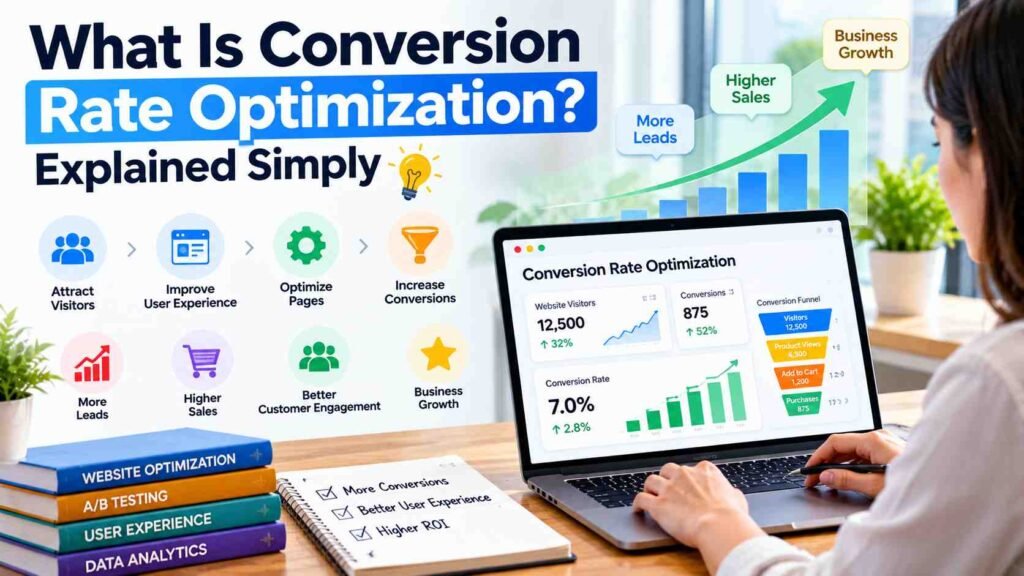
Getting people to your website is just the start. The real work is getting them to actually do something-like check out your services, fill a form, book a call, or buy. If visitors leave without taking action, you’re basically wasting your marketing spend.
That’s where conversion rate optimization comes in. Instead of just chasing more traffic, you focus on turning the visitors you already have into leads or customers.
If you’re spending on SEO, ads, or content, CRO is what connects your marketing to real business results. It’s why things like website design, messaging, speed, and user experience matter as much as getting people to your site in the first place.
What Is Conversion Rate Optimization and How Does It Work?
CRO just means making your website or landing page better so more people do what you want-like buy, enquire, book, or sign up. What counts as a conversion depends on your business goals.
For example, imagine your website receives 1,000 visitors in a month and 30 people submit an enquiry form. Your conversion rate is 3%.
Conversion rate = (Number of Conversions ÷ Total Visitors) × 100
In this example:
(30 ÷ 1,000) × 100 = 3%
If you improve your landing page and receive 45 enquiries from the same 1,000 visitors, your conversion rate increases to 4.5%.
You have generated 15 additional enquiries without increasing website traffic.
The main idea is that small, data-driven tweaks can help you get more out of the marketing you’re already doing.
- Identify the Right Conversion Goal
Before making changes, decide what success means for your website. An e-commerce store may prioritize completed purchases, while a hospital may focus on appointment bookings. A B2B company might measure qualified leads or quotation requests.
Choose a goal that reflects genuine business value rather than tracking every click as a conversion.
- Understand Where Visitors Drop Off
Use analytics to spot where people drop off, abandon forms, or get stuck. Don’t guess-let the data show you what needs fixing.
- Improve the User Journey
Make it obvious what you offer, why it matters, and what the next step is. Guide people from landing page to service info to enquiry form without confusion.
Why Is Conversion Rate Optimization Important for Businesses?
You can have thousands of visitors and still get barely any good leads. CRO helps you figure out why and fix it so your website actually supports your business goals.
- Get More Value From Existing Traffic
SEO and ads bring people in. CRO is about what happens next. If your pages answer questions and remove friction, more visitors will actually take action.
- Improve User Experience and Trust
People trust businesses with clear, easy-to-use websites. Make your service descriptions helpful, show real testimonials, keep contact info obvious, and use simple forms. That reduces doubt.
- Make Marketing Decisions With Evidence
Conversion improvements should be based on analytics, customer feedback, usability testing, and controlled experiments where possible. This reduces reliance on personal opinions and helps teams understand which changes actually make a difference.
CRO is not a replacement for SEO or paid advertising. It complements those activities by helping businesses turn relevant website visits into meaningful outcomes.
What Are the Best Conversion Rate Optimization Techniques?
Good CRO starts with knowing your audience and spotting what’s stopping them from converting. The best tactics depend on your site, your industry, and your goals.
- Write Clear, Benefit-Focused Headlines
Your headline should tell people what to expect and why it matters. Skip the generic stuff. For example, say how you help customers get more qualified leads instead of just calling yourself innovative.
Make sure your headline matches the ad, search result, or link that brought people in.
- Create Strong Calls to Action
A call to action (CTA) tells visitors what to do next. Examples include “Request a Consultation,” “Get a Quote,” and “Book an Appointment.”
Make your CTA stand out and use clear wording. On long pages, put CTAs near key info, but don’t overdo it with pop-ups or too many buttons.
- Simplify Forms and Navigation
Long forms turn people off. Only ask for what you really need at first-like name, business email, phone, and a quick description.
Also check whether visitors can easily find pricing information, service details, contact options, and answers to common questions.
- Optimize Mobile Experience and Page Speed
Many people browse websites on mobile devices. If buttons are difficult to tap, text is hard to read, or forms require excessive scrolling, visitors may abandon the process.
Test your website on different screen sizes and review loading performance. Optimize large images, reduce unnecessary scripts, and check whether important content appears quickly. These improvements support usability, although they do not guarantee a specific conversion rate.
- Use A/B Testing to Compare Changes
A/B testing compares two versions of a page or element to determine which performs better against a defined goal. You might test two headlines, CTA labels, or form layouts.
Change one major element at a time when practical, gather sufficient data, and avoid declaring a winner based on a few conversions. Results should be interpreted in context, particularly when traffic volumes are low.
How Can You Measure and Improve Conversion Performance?
CRO isn’t a one-time thing. It’s an ongoing process. Set a baseline, find the biggest issues, test changes, and keep tracking results.
Start by using analytics and conversion tracking to measure important actions. Google Analytics 4 can help track events and key events when configured correctly. Form submissions, phone enquiries, purchases, and bookings may also require tracking through your website platform or CRM.
Next, check the quality of your conversions. Lots of enquiries don’t mean much if they’re not the right fit or never turn into customers. Try to link website leads to actual sales so you know which channels are working.
Review these practical indicators:
- Conversion rate: The proportion of visitors who complete the chosen action.
- Lead quality: How closely enquiries match your ideal customer profile.
- Form abandonment: The extent to which users start but do not complete a form.
- Cost per lead: The marketing cost associated with generating a lead.
- Sales conversion rate: The proportion of leads that eventually become customers.
Use these metrics to spot your best opportunities. Improving a high-traffic service page by even a little can be worth more than redoing a page hardly anyone visits.
Businesses looking to combine website improvements with search visibility, content, and advertising can explore Best Digital Marketing Services in Hyderabad from SpaceKey Digital. A coordinated approach helps align traffic generation with website goals, lead tracking, and customer acquisition.
You can also review SEO services in Hyderabad to understand how organic search optimization can support relevant website traffic. For a website that needs broader structural or usability improvements, explore website development services.
There’s no magic conversion rate for every business. It depends on your industry, audience, offer, device, and how complex your sales process is. Always compare your numbers to your own past results and goals-not someone else’s benchmarks.
Final Thoughts
CRO is about looking past just traffic numbers and focusing on what visitors actually do. Make your pages clearer, forms simpler, CTAs stronger, and keep testing and tracking. That’s how you make your website actually useful for real customers.
Don’t start with a full redesign. Pick one real problem, measure how much it matters, and fix it based on data. Do this consistently and your website will generate better leads and smarter marketing decisions over time.
Ready to improve your website’s performance?
Contact SpaceKey Digital to discuss your digital marketing goals and explore practical ways to improve your website experience, lead generation, and conversion tracking.
FAQs
- What is conversion rate optimization? Explained simply for beginners?
What is conversion rate optimization? Explained simply means improving a website so more visitors complete a desired action, such as making a purchase or submitting an enquiry. It involves understanding visitor behaviour, identifying obstacles, and testing changes that may improve the experience.
- How do you calculate conversion rate optimization results?
To evaluate what is conversion rate optimization? Explained simply, first calculate your conversion rate by dividing conversions by total visitors and multiplying by 100. Compare the result over appropriate periods, account for traffic differences, and check whether conversion quality and business outcomes have improved.
- Is conversion rate optimization useful for small businesses?
Yes. Understanding what is conversion rate optimization? Explained simply can help small businesses improve enquiry forms, service pages, mobile usability, and calls to action without relying entirely on increased advertising spend. Begin with the changes most likely to address a real customer problem.
- How long does conversion rate optimization take?
When learning what is conversion rate optimization? Explained simply, remember that timelines depend on website traffic, conversion volume, and the complexity of the changes. Some usability issues can be fixed quickly, but reliable experiments may require several weeks or longer to collect enough data.
- Does conversion rate optimization replace SEO?
No. Understanding what is conversion rate optimization? Explained simply helps clarify that CRO and SEO serve different but complementary purposes. SEO helps attract relevant visitors through search, while CRO improves the website experience and encourages visitors to complete meaningful actions.