
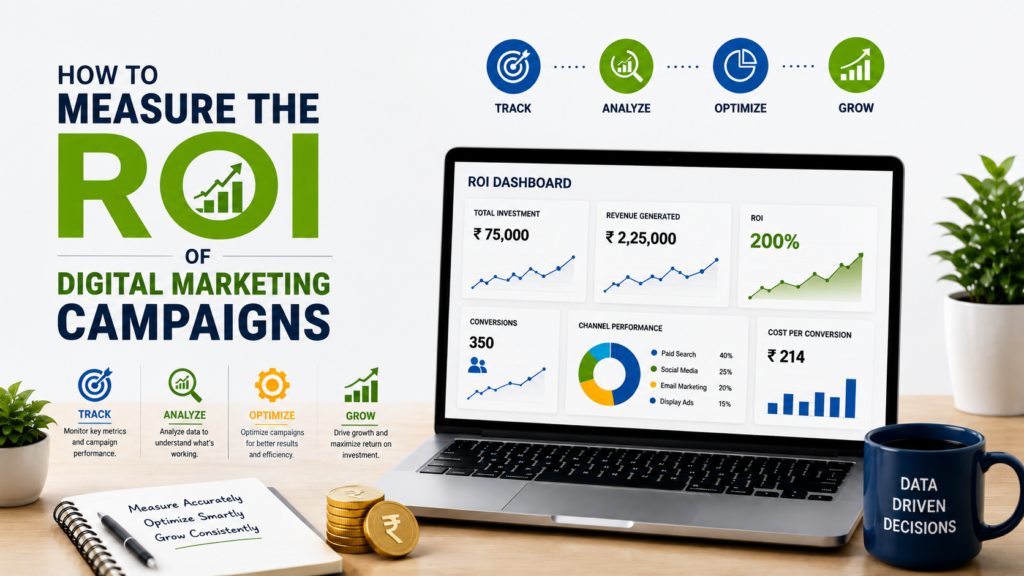
So digital marketing can bring in traffic, leads, and sales. But the real question is, which of these activities are actually driving business growth? It’s not enough to just run campaigns-you need to know what’s working.
That’s where measuring ROI comes in.
You might see thousands of impressions or hundreds of clicks, but those numbers alone don’t tell you if your spend was worth it. What matters is connecting your marketing spend to real outcomes-like qualified leads, actual sales, and revenue.
Measuring ROI shows you what’s working, where your money is being used well, and what needs fixing.
What Is Digital Marketing ROI?
Digital marketing ROI is just about figuring out how much money you actually make from what you spend on marketing.
A basic ROI calculation is
ROI = (Revenue Generated − Marketing Cost) ÷ Marketing Cost × 100
For example, if a business spends ₹50,000 on a campaign and generates ₹1,50,000 in attributable revenue:
ROI = (₹1,50,000 − ₹50,000) ÷ ₹50,000 × 100 = 200%
But it’s rarely this straightforward. Some businesses have long sales cycles, repeat customers, or leads that close offline. There are usually multiple touchpoints before someone buys.
So your measurement system should match how your business actually makes money.
1. Identify the Campaign Objective
Before you look at results, get clear on what you want the campaign to achieve.
Possible objectives include:
- Generate qualified leads
- Increase online sales
- Drive product purchases
- Generate phone enquiries
- Increase bookings
- Improve customer acquisition
- Increase repeat purchases
If your goal is brand awareness, you can’t judge it the same way as a campaign that’s supposed to drive sales.
2. Define Valuable Conversions
Not every action is equally valuable for your business.
A page view might show interest, but a completed purchase actually brings in money.
Depending on the business, important conversions may include:
- Contact form submissions
- Phone calls
- WhatsApp enquiries
- Product purchases
- Appointment bookings
- Demo requests
- Newsletter sign-ups
- Quote requests
Which Metrics Help Measure Marketing ROI?
Revenue matters, but you also need to look at other metrics to understand why a campaign is or isn’t profitable.
3. Cost Per Lead
Cost per lead tells you how much you’re paying for each enquiry.
CPL = Total Campaign Cost ÷ Number of Leads
For example, spending ₹40,000 and generating 200 leads produces a ₹200 cost per lead.
But don’t assume a lower CPL is always better. Cheap leads that never convert are just wasted spend.
4. Customer Acquisition Cost
Customer Acquisition Cost (CAC) is about what it really costs to get a paying customer, not just a lead.
CAC = Total Acquisition Cost ÷ Number of New Customers
This gives you a clearer picture, especially if most of your leads don’t turn into customers.
5. Conversion Rate
Conversion rate shows how well your traffic or leads are actually taking the action you want.
For example:
Conversion Rate = Conversions ÷ Visitors × 100
If your conversion rate is low, check your landing page, offer, targeting, pricing, messaging, or user experience. Something’s off.
6. Return on Ad Spend
ROAS is commonly used for paid advertising.
ROAS = Revenue Attributed to Ads ÷ Advertising Cost
If ₹20,000 in advertising produces ₹80,000 in tracked revenue, the ROAS is 4.
ROAS is helpful, but don’t confuse it with profit. You still have to factor in product costs, salaries, agency fees, tech costs, and everything else.
How Can You Track a Digital Marketing Campaign Properly?
You can’t measure ROI properly without solid tracking in place.
7. Set Up Conversion Tracking
Before you launch anything, figure out which actions matter for your business and set up tracking for those.
Depending on your setup, this may include tracking:
- Forms
- Calls
- Purchases
- Downloads
- Bookings
- WhatsApp clicks
- Lead-generation forms
If you skip tracking, you’ll have a hard time connecting your campaigns to real results.
8. Use UTM parameters to help you see exactly where your website traffic is coming from.
They can distinguish traffic from:
- Google Ads
- Meta Ads
- Email campaigns
- Social media posts
- Influencer campaigns
- Other promotions: This makes it easier to see which campaigns and sources are actually driving conversions. to conversions.
9. Connect Marketing With Sales Data
For a lot of service and B2B businesses, the sale doesn’t happen fully online.
A person may:
Click an advertisement → Submit an enquiry → Receive a sales call → Attend a meeting → Become a customer
If you only track the first enquiry, you won’t know if that lead actually turned into revenue.
Connect your marketing data with your CRM or sales info to get a real picture of your ROI.
How Should You Calculate ROI Across Different Channels?
Different channels play different roles in your customer’s journey.
10. Compare Channels Based on Business Outcomes
Don’t just compare channels by traffic or engagement.
Instead, examine:
- Qualified leads
- Conversion rates
- Customer acquisition cost
- Revenue
- Repeat purchases
- Customer lifetime value
- Profitability
For example, SEO takes longer to show results but keeps bringing in organic traffic over time. Paid ads give you quick traffic, but you have to keep spending.
Both are valuable, but you need to measure them differently.
Understand Attribution
A customer may interact with several marketing channels before converting.
For example:
Google Search → Blog Article → Instagram → Remarketing Ad → Website → Purchase
Which channel deserves credit?
There is no single attribution model that works perfectly for every business. Depending on the customer journey, businesses may use first-click, last-click, data-driven, or other attribution approaches.
The key is not to judge a channel without looking at its role in the whole customer journey.
What Can Businesses Do With ROI Data?
Measuring ROI only matters if you actually use the data to make better decisions.
Optimize Underperforming Campaigns
If your acquisition cost is high, don’t just change the budget. Figure out why first.
Possible issues include:
- Poor audience targeting
- Weak creative
- Expensive keywords
- Low-converting landing pages
- Poor offer positioning
- Irrelevant traffic
- Slow follow-up
Scale Strong Campaigns Carefully
If a campaign keeps bringing in profitable customers, it might make sense to invest more.
But scale up slowly. If you increase spending too fast, you might see changes in audience quality, costs, or efficiency.
Improve Landing Pages
If your ads are bringing in traffic but not conversions, the issue is probably not the ad itself.
Review:
- Headline
- Offer
- Call to action
- Page speed
- Trust signals
- Form length
- Mobile experience
Fixing the conversion experience can boost your returns without needing more traffic.
Common Mistakes When Measuring Marketing ROI
Businesses can misinterpret performance when they:
- Measure clicks instead of customers
- Ignore offline conversions
- Use incomplete tracking
- Count every lead as equally valuable
- Ignore customer lifetime value
- Compare channels using unrelated metrics
- Look at short-term results only
- Forget the difference between revenue and profit
A good measurement system combines your marketing data with your actual business data.
How Often Should You Review Marketing ROI?
You should check ROI regularly, but how often depends on your campaign size and sales cycle.
Paid campaigns usually need frequent checks-look at budget, costs, conversions, and lead quality.
SEO and content take longer to show results, so review them over a longer period. Organic growth isn’t instant.
A monthly review can examine:
- Campaign spending
- Leads
- Sales
- Conversion rates
- CAC
- ROAS
- Revenue
- Lead quality
A quarterly review helps you decide on bigger budget moves and overall strategy.
Conclusion
Actually, measuring ROI isn’t just about counting clicks or views. You need to see how your marketing spend connects to real customer actions, sales, and revenue.
Start by figuring out which conversions matter, set up proper tracking, connect your marketing with sales data, and watch the metrics that show real business performance.
When you measure your campaigns properly, you get the info you need to make better decisions. Don’t just ask how much traffic you got-ask something more useful:
What business value did that investment create?
When you move from just reporting activity to measuring real outcomes, your marketing budget becomes a lot more accountable and strategic.
Ready to Improve Your Marketing ROI?
At SpaceKey Digital, we help you build campaigns you can actually measure, set up better tracking, analyse what’s working, and create strategies that focus on real business results.
If you want to talk about your digital marketing goals or need a measurement-focused strategy, just reach out to SpaceKey Digital.
FAQs
- What is the easiest way to calculate Digital Marketing ROI?
A basic Digital Marketing ROI calculation subtracts marketing costs from attributed revenue, divides the result by marketing costs, and multiplies it by 100. Businesses should also consider profit and customer value for a more complete assessment.
- Why is Digital Marketing ROI important?
Digital Marketing ROI helps businesses understand whether their marketing investment is producing meaningful financial returns and provides evidence for improving campaigns and allocating budgets.
- What metrics should I track for Marketing ROI?
Useful Marketing ROI metrics include revenue, conversion rate, cost per lead, customer acquisition cost, ROAS, customer lifetime value, and qualified lead volume.
- How can I improve the ROI of a Digital Marketing Campaign?
Improving a Digital Marketing Campaign can involve refining audience targeting, improving advertisements, optimizing landing pages, strengthening follow-up, removing inefficient spending, and focusing more budget on profitable customer segments.
- Can SEO and content marketing have measurable Marketing ROI?
Yes. Marketing ROI from SEO and content can be assessed through organic conversions, qualified leads, sales, customer acquisition cost, and revenue attributed to organic search, although attribution may require a longer measurement period.