
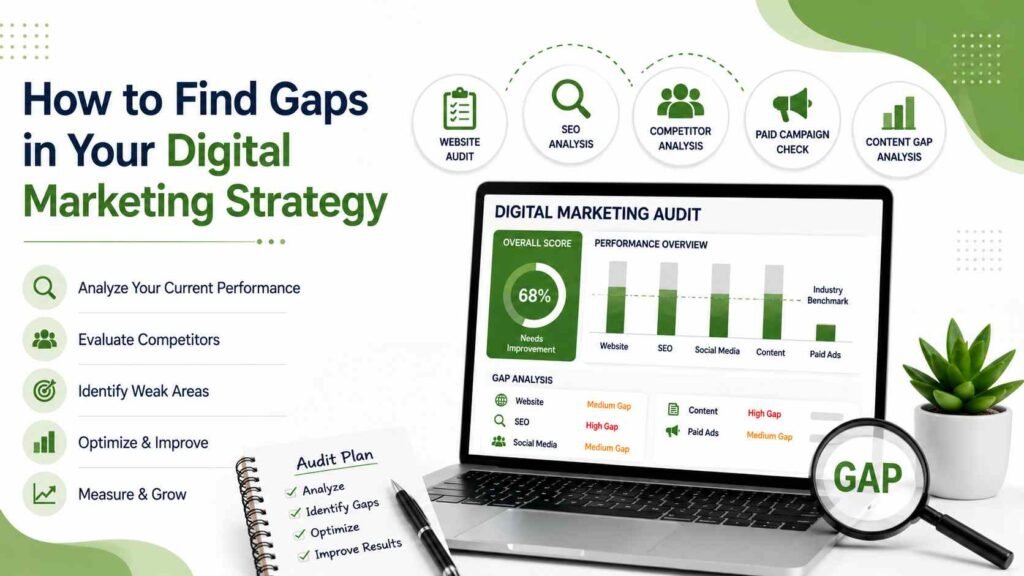
So, just because your digital marketing plan looks solid on paper doesn’t mean it’s actually working. You might be posting content, running ads, staying active on social, and spending on SEO, but sometimes the results just don’t add up to the time or money you’re putting in.
The issue isn’t always about doing too little. It’s often about the gaps between all those activities.
You may have traffic but very few enquiries. Your social media may generate engagement but no measurable business outcomes. Your website may attract visitors but fail to guide them toward an action. Or your SEO strategy may target keywords that bring visitors who have little interest in your services.
Actually, finding gaps in your digital marketing starts with looking at the whole customer journey, not just each channel by itself.
Why Digital Marketing Gaps Can Hurt Business Growth
A marketing gap is just where your current approach isn’t meeting a key business or customer need.
Some gaps are obvious. Others are hidden because each channel looks fine on its own.
For example, you might get 10,000 visitors a month. Sounds great, but if only a few turn into real enquiries, there’s probably a conversion issue.
Common gaps include:
Poor visibility in search results
Weak local SEO
Missing or outdated website content
Unclear positioning
Inconsistent social media messaging
Poor landing-page experience
Weak lead follow-up
Limited retargeting
No clear conversion path
Inadequate performance tracking
So, the first thing is to stop looking at each marketing activity by itself.
Look at how a prospect moves from discovery → consideration → enquiry → purchase → retention.
How to Find Gaps in Your Digital Marketing Strategy
1. Compare Your Goals With Actual Results
Start with the business objectives.
Are you trying to generate leads, increase online sales, improve brand awareness, attract local customers, or enter a new market?
Now compare those goals with actual performance.
For example:
Goal: Generate qualified leads
Current situation: High website traffic but few enquiries
Possible gap: Conversion optimization or lead-generation process
Goal: Increase local enquiries
Current situation: Competitors dominate local search results.
Possible gap: Local SEO and Google Business Profile optimization
This simple comparison can reveal where your strategy is failing to support the original objective.
2. Audit Your Target Audience
Your marketing may be reaching people, but are they the right people?
Review your audience segments and ask:
Who is most likely to buy?
What problems are they trying to solve?
What questions do they ask?
Which channels do they use?
What prevents them from purchasing?
What information do they need before contacting you?
Customer interviews, sales conversations, website analytics, reviews, enquiry forms, and support queries can all provide useful insights.
If you’re talking too much about features and your customers care about results, that’s a clear positioning gap.
3. Analyze Your Search Visibility
SEO gaps can prevent potential customers from discovering your business at the moment they need your products or services.
Review your:
Primary keywords
Long-tail keywords
Local search visibility
Service pages
Blog content
Internal linking
Technical SEO
Competitor rankings
Don’t just check if your website ranks somewhere.
Check if it actually ranks for the searches that matter to your business.
A website might receive significant organic traffic from informational queries while remaining almost invisible for commercially valuable service searches.
That’s a strategy gap, not just a traffic issue.
4. Examine Your Content Coverage
A strong content strategy should support different stages of the customer journey.
Look for gaps across:
Awareness: Are you answering basic questions and introducing the problem?
Consideration: Are you helping prospects compare solutions and understand your approach?
Decision: Do your service pages, case studies, testimonials, FAQs, and CTAs give prospects enough confidence to take action?
Retention: Are you continuing to educate and support existing customers?
A website with dozens of blog posts can still have a major content gap if those articles don’t connect to the products or services that generate revenue.
5. Review Your Website And Conversion Paths
Your website should make the next step obvious.
Check whether visitors can quickly understand:
What you offer
Who you serve
Why they should consider you
What makes your business different
How to contact you
What they should do next
Look at important pages individually.
A service page might attract visitors through SEO but have no strong CTA. A landing page might receive paid traffic but contain too much information. A contact form might ask for unnecessary details.
These kinds of conversion gaps quietly eat into your marketing ROI.
For businesses that need to improve the connection between SEO, content, website experience, and lead generation, professional digital marketing services can help bring these activities into a more coordinated strategy.
Audit Paid Advertising, Social Media, And Lead Management
6. Check Whether Your Paid Campaigns Match Your Goals
Paid advertising should be evaluated beyond impressions and clicks.
Review:
Targeting
Search terms
Ad messaging
Landing pages
Conversion tracking
Cost per lead
Lead quality
Campaign profitability
If your ads get lots of clicks but the leads are weak, dig into the whole process from ad to enquiry.
The problem could be your targeting, your offer, the landing page, or even how you qualify leads.
7. Identify Social Media Gaps
Social media can play different roles depending on your business.
It may help with awareness, trust, community building, customer education, or direct lead generation.
Review whether your content has a clear purpose.
For example, if every post is promotional, you may be missing educational and trust-building content.
If people engage with your posts but never visit your site or reach out, there’s probably a missing link between attention and conversion.
A better content mix can include:
Educational content
Customer stories
Industry insights
Product or service explanations
Behind-the-scenes content
FAQs
Offers
Expert-led content
8. Examine Your Lead Follow-Up Process
One of the biggest gaps I see is what happens after you get a lead.
You might spend money to get enquiries, but if you respond slowly or inconsistently, you’re wasting that effort.
Review:
How quickly are leads contacted?
Who follows up?
How many attempts are made?
Are leads categorized by quality or intent?
What happens when someone isn’t ready to buy?
Marketing and sales need to work together. Just getting form submissions doesn’t mean a campaign worked.
What matters is the quality of those leads and what actually happens next.
9. Compare Your Strategy With Competitors
Competitor research can reveal opportunities your business hasn’t addressed.
Study competitors across:
Search rankings
Website structure
Service pages
Content topics
Social media
Paid advertisements
Reviews
Offers
Calls to action
Don’t just copy your competitors.
Instead, ask where customers are receiving better information or a smoother experience from competing businesses.
A competitor may rank for an important topic you haven’t covered. Another may have a clearer service page. Someone else may have stronger social proof.
Each observation can become an improvement opportunity.
10. Measure The Full Customer Journey
The final step is connecting the data.
Look at the journey from first interaction to business outcome:
Impression → Click → Website Visit → Engagement → Lead → Qualified Lead → Sale
Identify where the biggest drop-offs occur.
For example:
High impressions + low clicks = messaging or targeting issue
High clicks + low engagement = landing-page relevance issue
High traffic + low leads = conversion issue
High leads + low sales = qualification or sales issue
High sales + low repeat purchases = retention opportunity
This way, your audit actually helps you see what matters, not just a bunch of channel metrics.
Turn Identified Gaps Into An Action Plan
Spotting problems is just the first step.
Make a priority list based on what will have the most impact, how much effort it takes, and how urgent it is.
For example:
Gap | Impact | Priority |
Poor service-page conversions | High | Immediate |
Missing local SEO optimization | High | Immediate |
Outdated blog content | Medium | Next |
Weak social engagement | Medium | Next |
Limited remarketing | Medium | Later |
Don’t try to fix everything in one go.
Start with the gaps that will actually move the needle for your business.
Businesses looking to strengthen organic visibility can also review SEO services and align search optimization with broader marketing objectives.
Final Thoughts
Actually, finding gaps in your digital marketing isn’t about pointing out everything that’s wrong. It’s about spotting where your current efforts aren’t really helping you hit your business goals.
Start by checking your goals, your audience, your search visibility, your content, your website, your ads, your social, your lead follow-up, your competitors, and the whole customer journey.
Then focus on the gaps that can make the biggest difference.
You don’t need every channel to be perfect. What matters is that the key parts work together to bring in the right people, build trust, generate leads, and actually grow your business.
Regular audits help you catch small issues before they turn into big, expensive problems.
Ready To Strengthen Your Digital Marketing Strategy?
If you need help identifying performance gaps and creating a more focused digital marketing roadmap, SpaceKey Digital can help evaluate your SEO, content, paid campaigns, website, social media, and lead-generation activities.
Contact SpaceKey Digital to discuss a strategy built around your business goals.
FAQs
1. How often should I review my digital marketing strategy?
A monthly performance review is useful for identifying immediate issues, while a more detailed quarterly audit can uncover larger opportunities. Regular reviews help businesses adjust their campaigns based on actual performance rather than assumptions.
2. What is the most common digital marketing gap businesses overlook?
One of the most common issues is focusing heavily on traffic or lead generation without examining what happens afterward. Businesses should also evaluate lead quality, conversion rates, follow-up processes, customer experience, and sales outcomes.
3. Can competitor analysis help improve my marketing strategy?
Yes. Reviewing competitors can reveal opportunities in areas such as SEO, content, website experience, offers, messaging, social media, and customer engagement. The objective is to identify areas where your business can provide more value rather than simply copying competitors.
4. How can I identify gaps in my SEO performance?
Review your keyword rankings, organic traffic, search visibility, service pages, technical SEO, local search presence, content quality, and search intent. You should also check whether your website is attracting relevant visitors who have the potential to become customers.
5. Should I hire a digital marketing agency to identify these gaps?
An experienced agency can provide a structured audit across SEO, content, paid advertising, social media, website performance, analytics, and lead generation. This can help identify priority areas and create a practical improvement plan based on your business objectives.