
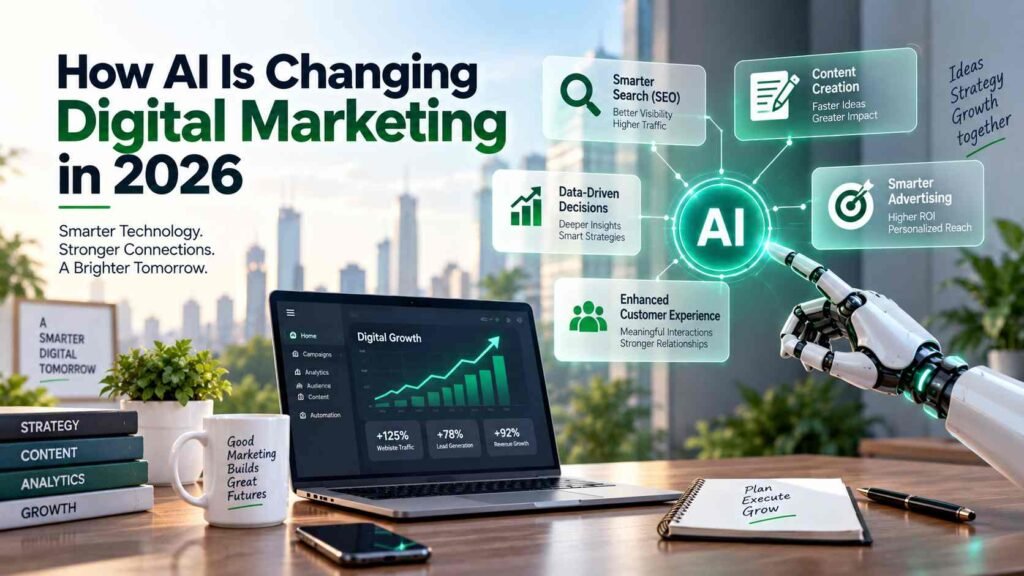
So, AI isn’t just a buzzword in digital marketing anymore. It’s now part of how we research audiences, create content, run campaigns, check performance, and actually understand what customers want.
The real shift isn’t just about making content faster. AI is changing how people search, how ads show up, how creative gets made, and how we make marketing decisions.
Google is introducing AI-powered experiences across Search, Ads, and Analytics, while Meta is expanding AI tools for advertising, customer conversations, and creative production.
If you’re still thinking of AI as just a small productivity hack, that’s outdated. The real value comes from using it with a clear strategy, keeping your brand’s originality, understanding your customers, and not forgetting about privacy or human judgment.
Here’s what actually matters for marketers in 2026.
AI Is Changing Search, Content, And Customer Discovery
Search behaviour is becoming more conversational and detailed. Instead of entering a few keywords, users increasingly ask complete questions and expect systems to understand context.
Google reports that AI Mode users are searching differently, including asking questions that more closely reflect what they actually want to know.
- Conversational Search Is Growing
So, you can’t just focus on keywords anymore.
Your content needs to answer real questions, explain things simply, and actually help people. Just stuffing keywords won’t get you anywhere-Google and your customers both want useful info.
- Content Quality Matters More Than Volume
AI can help you pump out more content, but more doesn’t always mean better marketing.
Businesses still need:
- Original insights
- Accurate information
- Firsthand experience
- Expert opinions
- Useful examples
- Clear explanations
- Strong brand perspective
Google’s 2026 marketing guidance emphasizes the growing importance of brand, useful content, and human differentiation as AI becomes more deeply integrated into marketing.
This is key: AI speeds things up, but you still need something valuable to say. Otherwise, you’re just adding noise.
- Search And Content Strategy Are Becoming More Connected
SEO, content, and brand visibility aren’t separate anymore. They all work together.
A good article should bring in search traffic, show your expertise, answer real customer questions, and help with conversions-all at once.
For businesses developing a stronger organic presence, Best SEO Services can complement a broader AI-aware search strategy.
AI Is Transforming Advertising And Personalization
Paid ads are changing fast too.
Google is expanding AI-powered advertising capabilities, while Meta is using AI to improve campaign setup, creative generation, audience understanding, and ad ranking.
- AI-Powered Campaign Optimization
Campaign management traditionally required marketers to manually monitor many combinations of audiences, keywords, placements, creatives, and bids.
AI can spot patterns and find opportunities in your campaign data that you’d probably miss manually.
Google’s AI Max for Search campaigns, for example, includes AI-powered capabilities for search-term matching, text customization, and final URL expansion. Google says campaigns using the full feature suite have seen an average of 7% more conversions or conversion value at similar CPA/ROAS compared with search-term matching alone.
But that doesn’t mean you should automate everything. You still need to set clear goals, track conversions, keep your creative strong, control your brand, and use your own judgment.
- Faster Creative Production
AI can help marketers create variations of advertising copy, images, videos, concepts, and other creative assets.
Meta says its AI-powered creative tools are increasingly being used to help businesses develop and scale advertising creative.
The big win here is speed. Your team can test more ideas without having to make every version by hand.
The challenge is differentiation.
If everyone uses the same AI prompts, everything starts to look the same. That’s why having a clear creative direction and strong brand identity matters even more now.
- More Personalized Customer Experiences
AI can help you pick up on what your customers actually care about and send them messages that make sense.
Personalization may involve recommending products, adjusting advertising messages, sequencing communication, or responding differently based on customer interactions.
But don’t get creepy with personalization. Make sure you have consent, keep privacy clear, and handle data responsibly.
Google emphasizes the importance of consented first-party data as AI becomes more important to marketing measurement and audience strategy.
AI Is Changing How Businesses Use Data And Automation
Marketing teams generate enormous amounts of information. Website analytics, advertising results, CRM records, customer interactions, social engagement, and sales data can be difficult to evaluate manually.
AI is making it easier to turn all that data into insights you can actually use.
- Faster Marketing Analysis
Google introduced AI-powered features in Ads and Analytics in 2026 that can summarize performance changes, generate visual reports through prompts, and provide recommendations.
This means less time digging through dashboards and more time making real decisions.
Instead of asking only:
“What happened?”
teams can increasingly ask:
“Why did it happen, what should we investigate, and what action should we take?”
- First-Party Data Becomes More Valuable
First-party data is information a business collects directly through legitimate customer interactions, such as purchases, enquiries, subscriptions, or website activity.
With privacy rules changing, you need to build real relationships with your customers instead of just relying on third-party data.
Google notes that consented first-party data can help businesses understand valuable customers, improve audience strategies, inform business decisions, and support machine-learning systems.
So, your CRM, conversion tracking, customer database, and privacy practices matter more than ever.
- AI Assistants Are Becoming Part Of Marketing Workflows
AI isn’t just for making content anymore. It’s getting into the day-to-day of marketing operations too.
Google’s Ask Advisor connects marketing data across Google Ads, Analytics, and Merchant Center to provide personalized recommendations.
Meta has also introduced Business Agent, designed to help businesses respond to customers and provide personalized experiences through AI.
We’re heading toward a future where AI isn’t just doing one-off tasks. It’s part of the whole workflow-from analysis to execution to talking to customers and optimizing results.
For businesses that want to combine these technologies with strategy and execution, SpaceKey Digital’s Digital Marketing Services can provide a broader foundation across SEO, advertising, social media, content, and lead generation.
What Businesses Should Do To Prepare For AI-Driven Marketing
Don’t start with, ‘Which AI tool should we buy?’
Start by figuring out your real business problems.
- Identify Repetitive Tasks
Look for tasks that eat up time but don’t need your constant attention or strategic thinking.
Examples include:
- Basic reporting
- Content variations
- Data summaries
- Campaign monitoring
- Meeting notes
- Customer-response drafts
- Research organization
These are the kinds of things AI can actually help with.
- Protect Brand Voice And Accuracy
Always review AI-generated content before you publish it.
Check facts, tone, claims, brand language, customer promises, and visual accuracy. Human review is especially important for healthcare, finance, legal, technical, and other areas where inaccurate information can create serious consequences.
- Invest In Original Brand Content
AI can generate generic information quickly. Your competitive advantage may therefore come from what AI cannot automatically know about your business.
Use:
- Customer stories
- Original research
- Expert interviews
- Proprietary insights
- Case studies
- Firsthand experiences
- Unique opinions
- Real campaign lessons
This kind of content is tough for others to copy and actually helps your audience.
Businesses looking to develop this type of expertise-led communication can explore SpaceKey Digital’s Content Marketing Services.
- Measure Business Outcomes
AI can increase marketing efficiency, but efficiency is not the same as growth.
Continue tracking meaningful outcomes such as:
- Qualified leads
- Revenue
- Conversion rate
- Customer acquisition cost
- Return on advertising spend
- Customer lifetime value
- Retention
- Organic visibility
The objective should be to use AI to make better decisions-not simply to produce more marketing activity.
Final Thoughts
So, the real way to look at AI in digital marketing for 2026 is to see it as a shift in how we actually do marketing.
Search is becoming more conversational. Advertising platforms are becoming more automated. Creative production is accelerating. Customer experiences are becoming more personalized. Analytics are becoming more intelligent, and marketing teams are gaining AI assistants that can help turn data into recommendations.
But just having the latest tech won’t give you a strong marketing strategy.
Businesses still need clear positioning, valuable content, accurate information, customer understanding, ethical data practices, strong creative thinking, and human judgment.
The brands that win with AI won’t be the ones churning out the most content. It’ll be the ones using AI smartly to understand customers, make better decisions, create real value, and build stronger relationships.
That’s the real opportunity with AI in digital marketing for 2026.
Ready to grow your business with a smarter digital marketing strategy?
Reach out today to discuss your goals and discover the right solutions for your business.
FAQs
1. How Is AI Changing Digital Marketing in 2026 for SEO?
AI is changing SEO by influencing how people search, how search engines understand content, and how marketers optimize websites. Businesses need to focus on useful, original, well-structured content that clearly answers user needs.
2. How Is AI Changing Digital Marketing in 2026 for Advertising?
AI is making digital advertising more automated and data-driven. Marketers can use AI to improve audience targeting, campaign optimization, creative testing, personalization, and performance analysis.
3. How Is AI Changing Digital Marketing in 2026 for Content Creation?
AI is helping marketers research ideas, create content variations, and speed up repetitive content tasks. However, human expertise, originality, fact-checking, brand voice, and strategic thinking remain important for high-quality content.
4. How Is AI Changing Digital Marketing in 2026 for Customer Experience?
AI is enabling businesses to provide faster and more personalized customer experiences through chatbots, AI assistants, recommendations, automated responses, and conversational interactions across digital channels.
5. How Is AI Changing Digital Marketing in 2026 for Small Businesses?
AI can help small businesses save time and resources by supporting content creation, customer communication, marketing analysis, research, and automation. The key is to use AI as a support tool while maintaining a clear brand strategy and human oversight.