So, AI isn’t just a buzzword anymore. It’s part of daily marketing work now. Most teams use AI for research, understanding customer behavior, coming up with content ideas, optimising campaigns, creating visuals, and automating the boring stuff.
Actually, picking the right tool is harder than it looks. There are hundreds of platforms out there, all promising faster content or smarter analytics. But more features don’t always mean better results. The real question is, does this tool solve a real marketing problem without messing up quality or losing the human touch?
In this guide, I’m focusing on practical ways you can actually use AI tools across SEO, content, ads, social media, design, analytics, and automation. No fluff-just what works.
How AI Is Changing Digital Marketing
AI is best for cutting down manual work-research, content creation, analysis, and campaign optimisation. It’s not here to replace marketers. Think of it as a productivity layer that helps your team move faster.
For example, an SEO specialist can use AI to organise keyword ideas and identify content gaps before applying their own search strategy. A content writer can use it for research and outlining while retaining editorial control over the final article.
Paid media teams can use AI-powered advertising platforms to analyse signals and optimise campaigns, while social media teams can use AI to develop content variations and ideas.
So, don’t pick tools just because they’re popular. Choose based on the actual task you need to solve.
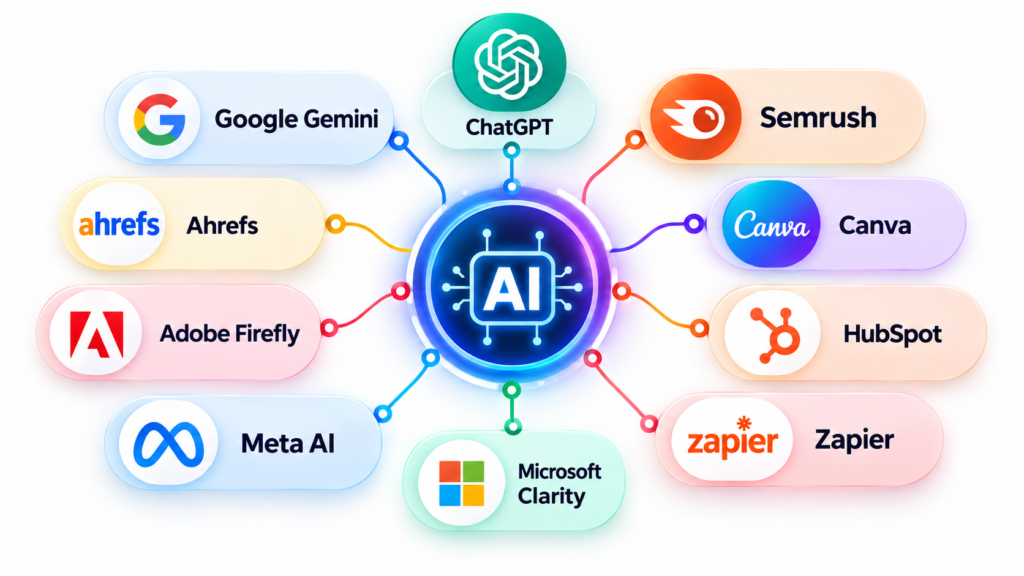
Here are ten important areas where AI tools can support marketing:
- Content research and writing
- SEO and search optimisation
- Keyword research
- Social media content
- Graphic and video creation
- Advertising optimisation
- Customer communication
- Data analysis
- Marketing automation
- Performance reporting
10 AI Tools Marketers Should Know
1. ChatGPT – Research, Content And Strategy
ChatGPT can support marketers with brainstorming, research assistance, content outlines, campaign ideas, audience questions, email drafts, ad variations, and strategic planning.
Its biggest advantage is flexibility. A marketer can use the same tool for different stages of a campaign, provided the output is reviewed carefully.
It should not be treated as an automatic publishing machine. Brand voice, factual accuracy, originality, customer insight, and expert review still matter.
2. Google Gemini – Research And Marketing Workflows
Google Gemini can assist with brainstorming, summarisation, research, content development, and other marketing tasks. Its integration with Google’s broader ecosystem can also make it useful for teams already working extensively with Google products.
The real value is using AI to speed up research and analysis, but always double-check important info before you publish anything.
3. Semrush – SEO And Competitive Research
Semrush provides a broad set of SEO and digital marketing tools, including keyword research, competitor analysis, site auditing, content-related workflows, and performance monitoring.
AI features in Semrush can speed up research and content work. But don’t just rely on keyword data-understanding customer intent and business goals still needs your input.
4. Ahrefs – Search And Content Research
Ahrefs is widely used for SEO research, backlink analysis, keyword discovery, content research, and competitor analysis.
AI in Ahrefs helps you handle lots of search and content data faster. It’s especially useful if you want to see how competitors are getting organic traffic and spot gaps for your own site.
5. Canva – AI-Powered Creative Production
Canva combines design tools with AI-assisted features that can help marketers create social media graphics, presentations, advertisements, images, and other marketing assets.
If you’re a small team, Canva can help you turn ideas into ready creatives faster. Just remember, consistency matters. Always review AI-generated designs to make sure they match your brand and message.
6. Adobe Firefly – Generative Creative Work
Adobe Firefly provides generative AI capabilities for creating and editing visual content. It can be useful for marketers who need to explore creative concepts, generate visual variations, or modify existing designs.
It’s most useful when you’re brainstorming. You can quickly try out different visual ideas before you move to final production.
7. HubSpot AI – Marketing And CRM Assistance
HubSpot integrates AI capabilities into its marketing, sales, and customer relationship tools. Depending on the products being used, marketers can apply AI to content, customer communication, CRM workflows, reporting, and other activities.
This is helpful if you want your marketing and customer data in one place, instead of jumping between disconnected tools.
8. Meta AI Tools – Social And Advertising
Meta continues to integrate AI into advertising and business products, including creative generation, campaign optimisation, recommendation systems, and business messaging.
If you’re running campaigns on Meta platforms, these AI features can automate parts of targeting, creative work, and campaign optimisation.
But don’t skip human checks, especially for brand safety, messaging, and customer experience.
9. Microsoft Clarity – Behaviour Analysis
Microsoft Clarity shows you how people use your website with behaviour analytics and session insights. AI features help you spot patterns and see where users get stuck.
This information can be useful for improving landing pages, navigation, forms, and conversion journeys.
10. Zapier – AI And Marketing Automation
Zapier connects different applications and can automate repetitive workflows. Its AI capabilities can assist with workflow creation and automation tasks.
For example, you can connect lead forms to your CRM, notifications, spreadsheets, or other tools. Automation cuts down admin work and helps your team respond faster and more consistently.
How To Choose The Right AI Tool
The best AI tools aren’t always the ones with the most features.
Start with the problem.
If the team spends too much time researching content, look for a research or SEO platform. If designers are overloaded with repetitive creative tasks, an AI-enabled design tool may provide more value. If leads are being manually transferred between systems, automation could be the better investment.
Also consider:
- Data privacy
- Integration capabilities
- Accuracy
- Human review requirements
- Pricing
- Team adoption
- Brand consistency
- Export and ownership options
Most importantly, don’t let AI replace real expertise.
Using AI Without Losing The Human Element
AI can make content fast, but speed doesn’t mean quality.
Good marketing still needs you to understand your customers, competitors, culture, positioning, and business context. AI might give you ten headlines, but only an experienced marketer knows which one actually works for the audience.
The same applies to SEO. AI can help organise information, but original insights, first-hand experience, expert input, and useful information are what make content valuable.
The best AI tools for digital marketing should therefore support human decision-making rather than eliminate it.
Here’s a simple workflow that works:
Research → AI assistance → Human review → Brand refinement → Fact-checking → Publishing → Performance analysis
This way, you stay efficient without losing quality.
Final Thoughts
The right AI tools can help you move faster, stay organised, and handle more information and creative work.
But tools alone won’t make your campaigns work. You still need strategy, audience understanding, creative thinking, accurate info, and ongoing optimisation.
Start by identifying your biggest marketing bottlenecks. Pick tools that actually solve those problems, and add AI into your workflow step by step.
If you want to understand how AI can be integrated with SEO, content, paid advertising, social media, websites, and lead generation, explore SpaceKey Digital’s digital marketing services.
FAQs
- What are the best AI tools for digital marketing?
The best AI tools for digital marketing depend on the task. ChatGPT and Gemini can support research and content, Semrush and Ahrefs can assist with SEO, Canva and Adobe Firefly support creative work, while HubSpot and Zapier can help with CRM and automation.
- Can the best AI tools for digital marketing replace marketers?
The best AI tools for digital marketing can automate repetitive tasks and accelerate research, but they do not replace strategic thinking, creativity, customer understanding, brand judgement, or expert review.
- Are the best AI tools for digital marketing useful for small businesses?
Yes, the best AI tools for digital marketing can be particularly useful for small teams because they can reduce repetitive work and help businesses produce research, content, creative concepts, and workflows more efficiently.
- How should businesses choose the best AI tools for digital marketing?
Businesses should choose the best AI tools for digital marketing according to specific problems, budget, integrations, accuracy, data requirements, team skills, and the amount of human oversight needed.
- Can the best AI tools for digital marketing improve SEO?
The best AI tools for digital marketing can support SEO research, content planning, keyword analysis, competitor research, and optimisation, but marketers should still prioritise useful, accurate, original content and sound SEO fundamentals.