
So, generating leads online isn’t just about running ads anymore. You have to figure out where your potential customers actually spend time, what they’re searching for, and which platform can actually move them closer to becoming a customer.
Google Ads and Meta Ads are the two main platforms most businesses use for online lead generation. Both can work, but they operate very differently.
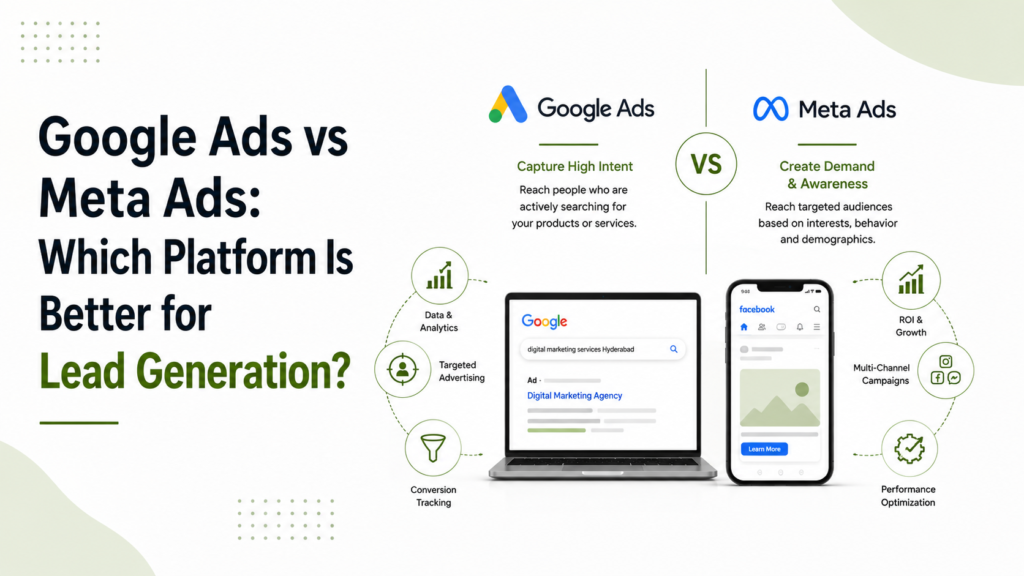
Google Ads can capture people who are already searching for a product or service. Meta Ads, which include advertising across Facebook and Instagram, can introduce an offer to people based on their interests, behavior, demographics, and interactions.
So, which one is better for Lead Generation?
Actually, it depends on your business, your audience, your sales cycle, your offer, your budget, and what you want to achieve. Don’t just pick a platform because it’s popular. You need to understand how each one fits into your customer journey.
How Do Google and Meta Advertising Campaigns Drive Enquiries?
The biggest difference is the user’s mindset.
With Google Ads, a person often starts with a search. They may already know what they need and actively look for a solution.
For example:
- Best dental clinic near me
- Industrial machinery supplier in Hyderabad
- Digital marketing company in Hyderabad
- Property for sale in Gachibowli
The person has already expressed an intention through the search query.
Meta Ads work differently. People generally visit Facebook or Instagram to consume content, communicate, or explore topics. They may not be actively searching for a product at that exact moment.
An advertisement can therefore create awareness or present an offer that matches their interests.
For example, a user scrolling through Instagram might see an advertisement for:
- A new apartment project
- A healthcare consultation
- A professional course
- A restaurant offer
- A business service
This difference in user intent is probably the most important thing to consider when you’re comparing Google Ads and Meta Ads.
When Are Google Ads Better for Lead Generation?
Google Ads usually work best when people are already looking for your product or service.
Search Intent Gives Google an Advantage
Someone typing a commercial search into Google has already taken an active step.
That intent can be valuable for industries such as:
- Healthcare
- Legal services
- Home services
- Education
- Real estate
- B2B services
- Professional consulting
- Local businesses
For example, someone searching for “SEO agency in Hyderabad” is likely much closer to making a business decision than someone simply seeing an advertisement while scrolling through social media.
But just because someone searches on Google doesn’t mean they’re a qualified lead. You still need to get your keywords right, watch your competition, make sure your ads and landing pages are relevant, and track conversions properly.
Google Ads Can Capture High-Intent Searches
Search campaigns can be built around different levels of intent.
Informational searches may require educational content.
Commercial searches can be targeted with service-focused landing pages.
Highly specific transactional searches may indicate that a person is ready to contact a business.
So, if you structure your campaigns properly, you can match your ads to where the customer is in their buying journey.
Local Businesses Can Benefit From Search Demand
For businesses serving a specific area, Google Ads can help capture local intent.
A Hyderabad business may target searches connected to:
- Hyderabad
- Kukatpally
- Kompally
- Gachibowli
- Madhapur
- Kondapur
- Miyapur
Location targeting lets you spend your budget only where you actually serve customers. No point wasting money on areas you don’t cover.
When Can Meta Ads Be Better for Lead Generation?
Meta Ads work well when your product or service looks good visually, needs audience segmentation, or when you have to create demand from scratch.
Meta Works Well for Discovery
A potential customer does not need to search for your business before seeing your advertisement.
This can be useful for products or services that are easier to sell through compelling visuals, demonstrations, testimonials, offers, or storytelling.
Examples include:
- Real estate
- Education
- Fashion
- Hospitality
- Restaurants
- Consumer products
- Events
- Fitness
- Lifestyle businesses
Audience Targeting Creates Opportunities
Meta offers audience targeting based on available platform signals, customer data, interests, behaviors, demographics, and engagement.
This means you can show your offer to people who actually fit your ideal customer profile.
The strength of this approach is that advertising can reach potential customers before they begin an active search.
Creative Quality Matters
On Meta, creative often plays a major role in campaign performance.
A strong image, video, message, or offer can stop the scroll and encourage someone to take action.
Businesses can test:
- Short-form videos
- Testimonials
- Product demonstrations
- Static creatives
- Carousel formats
- Offers
- Different calls to action
So, Meta is especially useful if you can create engaging visual content. If you can’t, you’ll struggle to get results here.
Google Ads vs Meta Ads: Key Differences
|
Factor |
Google Ads |
Meta Ads |
|
User Intent |
Often high search intent |
Usually discovery and interest-driven |
|
Primary Strength |
Capturing existing demand |
Creating and influencing demand |
|
Main Formats |
Search, Display, YouTube, Shopping |
Facebook, Instagram, and related placements |
|
Creative Importance |
Important |
Often critical |
|
Keyword Targeting |
Major role in Search |
Not the primary targeting method |
|
Visual Storytelling |
Moderate to high depending on format |
Very important |
|
Local Search |
Strong |
Useful but different from search intent |
|
Remarketing |
Available |
Strong remarketing capabilities |
|
Best Fit |
High-intent services |
Discovery and visual-led offers |
The right platform depends on your actual business goals, not just which one has more users.
Is Google or Meta More Affordable for Generating Leads?
The answer varies because campaign costs depend on factors such as audience, industry, competition, targeting, and conversion performance.
A cheaper lead doesn’t always mean a better lead.
Suppose Meta generates 100 enquiries at ₹300 each, while Google generates 30 enquiries at ₹900 each.
At first glance, Meta looks much cheaper.
But imagine that only five Meta enquiries become customers while fifteen Google leads become customers.
In that situation, Google may produce the stronger business result despite having a higher cost per lead.
So, you need to look at:
- Cost per lead
- Qualified lead rate
- Customer acquisition cost
- Conversion rate
- Revenue
- Profitability
This is where having a proper performance marketing strategy actually matters.
What Role Does the Landing Page Play?
The ad platform just gets people to your website or landing page.
What happens next depends on your landing page.
A good landing page should:
- Match the advertisement
- Clearly explain the offer
- Load quickly
- Work well on mobile
- Build trust
- Make the next step obvious
For example, if a Google advertisement promotes “Free Consultation,” the landing page should immediately explain the consultation rather than sending visitors to a generic homepage.
The same principle applies to Meta campaigns.
A weak landing page can ruin even the best-targeted ad campaign.
Why Conversion Tracking Matters on Both Platforms
If you don’t track conversions properly, you can’t really compare Google Ads and Meta Ads.
Businesses should configure appropriate conversion events based on their goals.
Possible conversions include:
- Lead forms
- Phone calls
- WhatsApp enquiries
- Purchases
- Appointment bookings
- Demo requests
- Sign-ups
Don’t just count every lead as equal. Track what actually turns into real business.
Wherever you can, connect your ad data with your sales data. That’s how you know which platform is actually bringing you customers.
Should You Use Google Ads or Meta Ads First?
Start by understanding how your customers actually behave.
Choose Google Ads First When:
- Customers actively search for your service
- The product has clear search intent
- You need high-intent enquiries
- Local search is important
- Your service solves an immediate problem
Choose Meta Ads First When:
- The product is visually appealing
- You need to create demand
- Audience targeting is important
- Video or creative can explain the offer
- Your business benefits from discovery and remarketing
Consider Using Both When:
Your customer journey includes both discovery and active search.
For example, a real estate brand may use Meta to introduce a project to potential buyers and Google Ads to capture people later searching for property in that location.
Both platforms can actually support different stages of your customer’s buying journey.
How a Performance Marketing Agency Should Manage Both Platforms
Don’t treat Google and Meta as separate systems. They should work together as part of your overall marketing strategy.
Your campaigns should actually work together, not in silos.
For example:
Meta Ads → Awareness
↓
Website Visit
↓
Remarketing
↓
Google Search
↓
Landing Page
↓
Lead
↓
Sales Follow-Up
When you integrate your approach, you can actually see how customers move between channels.
You (or your agency) should keep comparing channel performance and move budget based on real business results, not just assumptions.
Common Mistakes Businesses Make
Some advertisers judge platforms too quickly.
Common mistakes include:
Comparing Only CPC
A cheap click means nothing if it doesn’t turn into a customer.
Ignoring Creative Fatigue
Meta campaigns can lose effectiveness when the same creative is shown repeatedly to the same audience.
Using Broad Keywords Without Control
If you don’t manage your Google campaigns well, you’ll end up paying for clicks from people who aren’t even looking for what you offer.
Sending All Traffic to the Homepage
A dedicated landing page for each campaign helps guide visitors to take the action you want, without distractions.
Failing to Track Offline Sales
If your sales happen offline and you don’t connect that data back to your ads, your lead-gen campaigns will always look weaker than they really are.
Which Platform Is Better for Your Business?
There’s no one-size-fits-all answer when it comes to Google Ads vs Meta Ads.
Google can be stronger when the customer already knows what they need and is actively searching.
Meta can be stronger when you need to build demand, reach a specific audience, or communicate through powerful visual content.
A lot of businesses actually get the best results by using both together.
The important question is not
“Which platfoThe right platform depends on your audience, your offer, your sales process, and what you want to achieve and your marketing objective.
That is the approach to a strong Performance Marketing Hyderabad strategy. So, choosing between Google Ads and Meta Ads should start with your business model and how your customers actually behave. Don’t just follow trends. than advertising trends.
Google Ads is often valuable for capturing existing demand, while Meta Ads can be powerful for creating awareness, reaching defined audiences, and using visual storytelling.
For some businesses, one platform is enough. For others, using both together builds a much stronger lead generation system.
The best way is to test, measure, learn, and move your budget based on what actually brings in qualified leads and customers.
If you want to build a real lead generation system using Google Ads, Meta Ads, and data-driven marketing, let’s talk.
Reach out to SpaceKey Digital, and we can discuss your goals and build a performance marketing strategy that actually fits your business.
FAQs
1. Is Google Ads better than Meta Ads for Lead Generation?
Google Ads can be stronger when users actively search for your product or service, while Meta Ads can work well for audience discovery and demand creation. The right choice depends on your customer journey.
2. Are Meta Ads cheaper than Google Ads?
Not necessarily. Meta Ads may produce lower-cost enquiries in some campaigns, but businesses should compare qualified leads, customer acquisition costs, and revenue rather than lead price alone.
3. Which platform is better for local businesses?
Google Ads can be highly useful for local businesses because customers often search for services nearby. Meta can complement this by building awareness and remarketing to potential customers.
4. Can I run Google Ads and Meta Ads together?
Yes. Using both can help businesses reach customers at different stages, from initial discovery through active search and remarketing.
5. Why are my Google Ads or Meta Ads not generating leads?
Possible causes include poor targeting, weak creative, irrelevant keywords, ineffective landing pages, incorrect tracking, or an offer that does not match audience needs.