
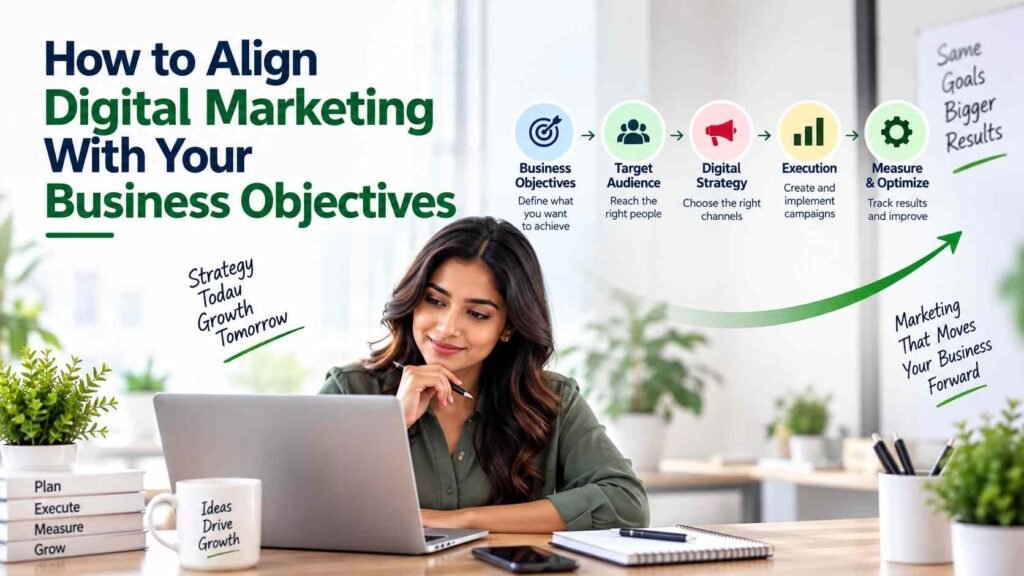
So, digital marketing only makes sense if it’s tied to what your business actually needs. More followers, website traffic, or impressions might look good on paper, but they don’t always mean your business is growing.
The first thing I ask is: What’s the real business outcome we want, and how does marketing help us get there?
It could be more leads, higher sales, entering a new market, better retention, stronger brand awareness, or getting more value from existing customers. Once you know the main goal, it’s much easier to decide what to focus on and how to measure progress.
If you don’t connect marketing to your business goals, you end up with random campaigns that don’t add up to real results. The whole point is to make sure your marketing spend actually drives business growth.
Start With Clear Business Objectives
Don’t start by picking a social platform or running ads. Start by getting clear on what the business actually needs to achieve.
If the business goal isn’t clear, no marketing strategy will work.
1. Define The Main Business Goal
Figure out what matters most for your business right now.
For example:
- Increase monthly sales
- Generate more qualified leads
- Launch a new service
- Expand into a new location
- Improve brand awareness
- Increase repeat purchases
- Reduce customer acquisition costs
- Improve website conversions
Every business goal needs its own marketing approach.
A business focused on lead generation may prioritize SEO, Google Ads, landing pages, and conversion optimization. A company launching a new consumer product may need stronger awareness through social media, video, creators, and paid campaigns.
2. Convert Business Goals Into Marketing Goals
Once you know the business goal, break it down into specific marketing actions.
Suppose a B2B company wants to increase sales from a particular service. Instead of simply saying “increase online visibility,” the marketing team could establish goals around qualified website enquiries, relevant search traffic, landing-page conversions, and lead quality.
This creates a direct connection between the business objective and marketing execution.
3. Use SMART Goals Where Appropriate
Set marketing goals that are specific, measurable, realistic, and have a clear timeline.
Instead of:
“We need more leads.”
Use:
“Generate 100 qualified enquiries over the next 90 days while maintaining an acceptable cost per qualified lead.”
That second goal actually tells you what to plan for and how to track if you’re on the right path.
Match Channels To The Customer Journey
Not every digital channel is equally useful for every business objective. The right choice depends on your audience, industry, buying cycle, resources, and desired outcome.
This is a critical part of how to align digital marketing with your business objectives because channel selection should follow the goal—not the other way around.
4. Choose Channels Based On Audience Behaviour
Consider where your customers actually spend time and how they search for information.
SEO can be valuable when potential customers actively search for solutions.
Google Ads can help capture high-intent searches and generate immediate visibility.
Social media can support awareness, engagement, community building, and product discovery.
Email marketing can help nurture prospects and maintain relationships with existing customers.
Content marketing can educate audiences and support both search visibility and consideration.
You don’t need to be everywhere. Focus on the channels that actually connect with your audience and support your business goal.
5. Map Marketing Activities To Funnel Stages
A customer may interact with a business several times before becoming a customer.
A simple journey might look like:
Awareness → Interest → Consideration → Conversion → Retention
Different activities can support different stages.
At the awareness stage, businesses may use social content, video, PR, or educational content. During consideration, detailed service pages, case studies, comparisons, reviews, and webinars can help. At the conversion stage, landing pages, offers, consultation forms, and sales communication become more important.
After purchase, email, customer support, loyalty campaigns, and useful content can help maintain the relationship.
6. Build A Connected Content Strategy
Don’t create content just to fill up a calendar.
Each content asset should have a purpose.
A blog might target an informational search. A case study might support prospects evaluating your service. A product demonstration could remove a common objection. A short video might introduce your brand to a new audience.
For businesses that want to develop content around customer intent and commercial objectives, SpaceKey Digital’s Content Marketing Services can support a broader content-led strategy.
Connect KPIs, Budget, And Performance
A strategy becomes difficult to manage when success is measured only through surface-level engagement.
Those numbers are fine for context, but you need to track metrics that actually tie back to your business goals.
7. Select KPIs That Reflect The Goal
The right KPI depends on what you are trying to accomplish.
Generate leads | Qualified leads, conversion rate, CPL |
Increase sales | Revenue, transactions, ROAS |
Improve awareness | Reach, branded searches, impressions |
Increase website demand | Organic traffic, engaged sessions |
Improve conversions | Conversion rate, enquiries, sales |
Retain customers | Repeat purchases, retention rate |
Expand locally | Local rankings, calls, directions, enquiries |
Don’t track a long list of metrics just because you can. Pick a few KPIs that actually matter and stick to them.
8. Allocate Budget According To Opportunity
Spend your marketing budget where it supports your main business priorities.
If organic search is already generating valuable leads, investing in SEO may support longer-term growth. If a new product needs immediate exposure, paid advertising may deserve greater short-term investment.
You don’t have to stick with one channel forever. Shift your budget as you learn what’s working.
9. Measure The Complete Conversion Path
A campaign can look successful at one stage while underperforming commercially.
For example, an advertisement may receive a strong click-through rate but produce very few qualified enquiries. That could indicate a mismatch between the advertisement, landing page, audience, offer, or sales process.
Don’t just stop at the first click. Track the whole journey.
A useful measurement chain is:
Ad/Search/Social → Website Visit → Engagement → Lead → Qualified Lead → Sale → Customer Value
This broader view helps businesses identify where potential customers are being lost.
For businesses looking to strengthen the SEO and organic side of their marketing strategy, SpaceKey Digital’s SEO Services can be incorporated into a wider growth plan.
Make Marketing And Sales Work Together
One of the biggeA lot of businesses have a big gap between marketing and sales.report that it generated hundreds of leads, while sales may say that very few were worth pursuing. Without a shared definition of a good lead, both teams can believe the other side is responsible for the problem.
10. Define What A Qualified Lead Means
Marketing and sales should agree on basic qualification criteria.
Depending on the business, this could include:
- Industry
- Location
- Company size
- Budget
- Service requirement
- Purchase timeline
- Decision-making authority
- Level of demonstrated interest
When you know what a good lead looks like, you can focus your marketing on getting more of them instead of just chasing form fills.
11. Improve Lead Follow-Up
Even a great campaign can fail if you don’t follow up with leads the right way.
Create a clear process for:
- Receiving new enquiries
- Assigning leads
- Responding quickly
- Recording conversations
- Following up
- Identifying qualified opportunities
- Reporting sales outcomes back to marketing
You need this feedback loop. When marketing knows which leads actually turn into customers, you can keep improving your campaigns to get better results.
12. Keep Messaging Consistent
The promise made in an advertisement should match the landing page and sales conversation.
If an advertisement promotes a specific offer but the landing page provides unrelated information, the customer experience becomes confusing.
Consistent messaging across ads, website pages, social content, emails, and sales communication can make the journey clearer.
Businesses looking for a broader approach can explore SpaceKey Digital’s Digital Marketing Services to connect multiple digital channels with business-focused objectives.
Review, Learn, And Adjust The Strategy
Don’t treat digital marketing as a set-and-forget plan. Things change too fast for that.
Customer behaviour changes. Competitors launch new campaigns. Search patterns shift. Advertising costs fluctuate. New opportunities appear.
You need to review your strategy regularly if you want to stay on track.
13. Conduct Monthly Performance Reviews
Review the KPIs that matter to the business.
Ask:
- Which channels generated meaningful opportunities?
- Which campaigns performed below expectations?
- Which content attracted qualified visitors?
- Where are prospects dropping out?
- Which audiences converted?
- Are marketing costs sustainable?
- Did marketing contribute to the original business objective?
The point of a review isn’t just to make a report. It’s to figure out what to do next.
14. Test Before Making Major Changes
If things aren’t working, don’t change everything at once.
Test individual elements such as:
- Headlines
- Ad creatives
- Landing-page messaging
- Calls to action
- Audience segments
- Offers
- Content formats
- Keyword groups
That way, you actually know what made the difference.
15. Reallocate Resources Based On Evidence
If one channel keeps bringing in good leads and another just creates noise, it’s time to rethink your strategy.
However, avoid judging every channel using the same short-term metric. SEO, brand building, email, paid search, and social media can play different roles and operate on different timelines.
The main thing is to know how each channel helps you reach your bigger business goal.
Common Mistakes To Avoid
Even a well-funded marketing strategy can lose direction when business objectives are not clearly connected to execution.
Some common mistakes include:
Chasing vanity metrics: A growing follower count does not necessarily mean revenue is growing.
Using every platform: More channels can create more work without producing better results.
Changing campaigns too quickly: Some strategies require enough time and data before their performance can be evaluated fairly.
Ignoring the sales process: Marketing cannot receive accurate feedback if sales outcomes are never tracked.
Using disconnected messaging: Different promises across advertisements, websites, and sales conversations can reduce trust.
Failing to revisit objectives: Business priorities can change, so marketing plans should evolve with them.
So, it’s not about finding the perfect channel. It’s about building a system where your goals, audience, marketing actions, measurement, and business results all work together.
Final Thoughts
Digital marketing only works when it has a clear job.
Start with what you want the business to achieve. Turn that into clear marketing goals. Know your audience, pick channels based on how your customers actually behave, create content that matches their intent, set KPIs that matter, connect marketing with sales, and keep reviewing what’s working.
Don’t confuse being busy with making progress. The best strategy isn’t the one with the most clicks or followers. It’s the one that actually moves your business forward.
When businesses understand how to align digital marketing with your business objectives, marketing becomes easier to prioritize, easier to measure, and more closely connected to sustainable growth.
Ready To Align Your Digital Marketing With Your Business Goals?
If you want to connect your SEO, content, paid campaigns, social media, website, and lead-generation efforts with your business objectives, SpaceKey Digital can help.
Contact SpaceKey Digital to discuss a focused digital marketing strategy built around your goals, audience, and customer journey.
FAQs
1. Why is it important to understand how to align digital marketing with your business objectives?
Understanding how to align digital marketing with your business objectives helps ensure that marketing activities support meaningful outcomes such as leads, revenue, customer retention, market expansion, or brand growth instead of focusing only on engagement metrics.
2. How should a company set digital marketing goals?
When considering how to align digital marketing with your business objectives, start with the desired business outcome and translate it into specific, measurable marketing targets that can be reviewed over a defined period.
3. Which digital marketing channels should a business use?
The right channels depend on the audience, industry, buying journey, budget, and objective. Learning how to align digital marketing with your business objectives means selecting channels based on their potential contribution rather than simply following popular platforms.
4. What KPIs should businesses track?
The appropriate KPIs depend on the goal. As part of how to align digital marketing with your business objectives, businesses can track qualified leads, conversion rates, revenue, customer acquisition cost, organic traffic, advertising returns, retention, and other meaningful measures.
5. How often should a digital marketing strategy be reviewed?
Regular reviews are useful because campaign performance and business priorities can change. A practical approach to how to align digital marketing with your business objectives includes ongoing monitoring with more detailed monthly or quarterly reviews.