
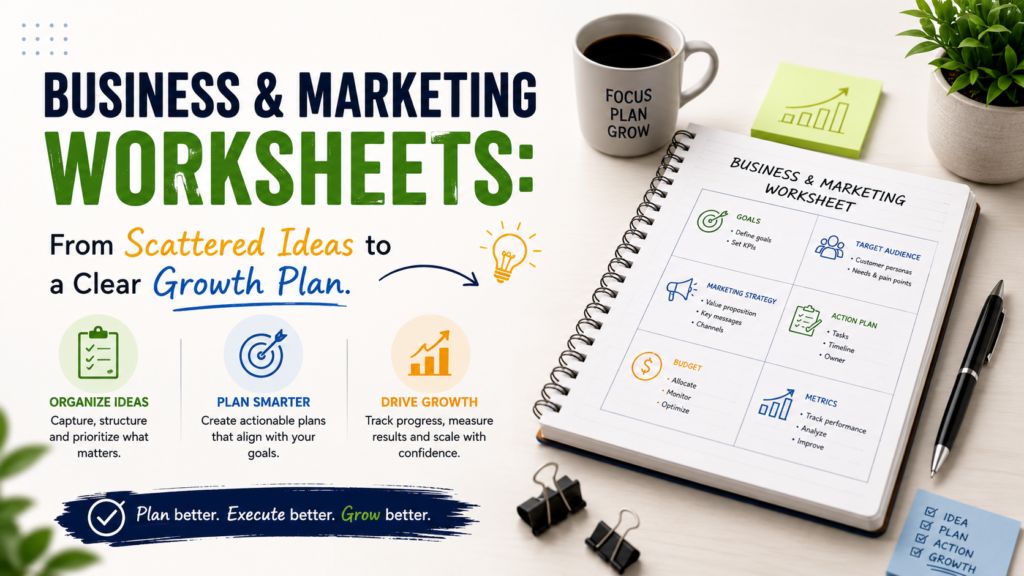
Most business owners I meet already have plenty of marketing ideas. You could probably name ten things to try right now: maybe a new reel, Google Ads, an email sequence, or a referral push. The real issue isn’t coming up with ideas.
The problem is, ideas without structure don’t help you figure out what actually matters. Should you run ads before you know who you’re targeting? Should you post more or fix your value proposition first? Which channel is worth your time and budget, and which one is just noise?
It’s almost never about effort. It’s about not having a clear structure. If you don’t write down your decisions about your business, your market, and your marketing, you end up reacting. You chase whatever feels urgent instead of focusing on where the real opportunity is.
That’s where business and marketing worksheets actually help. A good worksheet isn’t just a form you fill out and forget. It forces you to answer the important questions, one at a time, so your decisions aren’t just floating around in your head or scattered across random notes.
Find the Gaps. Understand the Opportunity. Plan the Next Move.
A good worksheet doesn’t just record what you know. It shows you what you’re missing.
You might sit down expecting to quickly define your target audience and realize you’ve actually been marketing to three different types of customers with one message. You might try to write your value proposition and notice it sounds identical to your competitors’. You might map your customer journey and find that nothing guides a person from “just found you” to “ready to buy.”
You don’t see any of this when your ideas are scattered. You only spot it when you’re forced to get specific.
That’s the thinking behind the SpaceKey Business & Marketing Workbook: find the gaps, understand the opportunity, and plan your next move. This isn’t just a slogan. It’s the actual process the workbook takes you through, from understanding your business, to reading your market, to building a strategy you can actually use.
What this Business & Marketing Workbook Actually Is
The Business & Marketing Workbook is a free resource from SpaceKey Digital. It’s 34 worksheets, split into six chapters, and the order matters. It’s not just a marketing planning tool. Before you even get to campaigns or channels, you need to get clear on your business first.
Here’s the six-part journey the workbook takes you through.
01. Understand Your Business
Strategy doesn’t start with promotion. It starts with a real look at the business you’re running: what you offer, how things work, and where you stand right now. If you skip this and jump straight to tactics, you end up promoting an inaccurate version of your business. This chapter is there so everything else in the workbook is built on facts, not guesses.
02. Understand Your Market
Once you’re clear on the business, the workbook shifts to the market. Here, you dig into your target audience, your value proposition, your competitors, and what you actually offer. The goal is to get a real understanding of your market, not just a guess.
This chapter comes before marketing strategy for a reason. You can’t build a strategy for a market you haven’t really looked at.
03. Build Your Marketing Strategy
Once you understand your business and your market, then you get into marketing strategy: campaigns, channels, positioning, pricing, and planning. This is where the earlier work pays off. Now your strategy is based on who you’re targeting and what sets you apart, not just whatever channel is trending right now.
04. Build Your Sales System
Marketing strategy gets people’s attention. This chapter is about what happens next: your sales funnel, the customer journey, and the steps that move someone from not knowing you to actually buying.
This is one of the most useful parts of the workbook. Most marketing plans skip this: not everyone you reach is ready to buy. The workbook uses the AIDA framework and awareness stages to break down the process:
Unaware → Problem Aware → Solution Aware → Product Aware → Ready to Purchase
Someone who doesn’t even know they have the problem you solve needs something totally different from someone who’s already comparing you to a competitor. If you talk to everyone like they’re ready to buy, you’ll get lots of impressions but not many conversions. This chapter helps you map your sales system to these stages, so your messaging actually fits where your audience is right now.
05. Prioritize What Matters
Not every gap you find needs the same attention. Some are urgent, some can wait. Some channels are worth your time, others just waste your budget.
This chapter is all about prioritizing. It helps you use the evidence you’ve gathered to decide what to tackle first, instead of trying to fix everything at once.
06. Plan the Move
The last chapter is where strategy turns into action. Here’s where you do go-to-market planning, SWOT analysis, project planning, goal-setting, and track your costs and income. This is the practical part, actually doing what you figured out in the earlier chapters.
Without this chapter, everything else is just theory. With it, you actually close the loop between understanding your business and taking action.
Why the Sequence Is the Real Value
It’s easy to think the value is just having 34 templates in one place. That’s not it. There are plenty of worksheet packs out there, but most are just a pile of disconnected templates you fill out in any order, and most people stop using them after a week.
What makes this workbook different is that it’s not just a collection. It’s a sequence, and the order matters:
Understanding → Analysis → Strategy → Sales → Prioritization → Execution
Each chapter builds on the last. Your marketing strategy is only as strong as your understanding of the market. Your sales system only works if your marketing is actually bringing people in. Priorities only make sense when you know where the real gaps are. And none of it matters if you don’t turn it into a plan you actually execute.
If you work through the worksheets out of order, like starting with a campaign worksheet before you know your target audience, you end up with the same scattered marketing most businesses already have. The sequence is what turns 34 worksheets into one clear process.
A Simple Example of How This Plays Out
Let’s say you sit down to fill out the target audience worksheet and realize you’ve been describing your ideal customer in three different ways: on your website, in your ads, and on sales calls. That’s a gap. It’s easy to miss when it’s just in your head, but obvious once you see it on paper.
Spotting that gap is just the start. Maybe your real audience is narrower and more specific than you thought. That’s actually a good thing. It means you can sharpen your messaging instead of trying to talk to everyone.
The next step is obvious: go back to the value proposition worksheet, tighten your positioning, and bring that clarity into your marketing strategy. One worksheet, one honest answer, and you’ve made a decision that actually changes what you do next.
Who the Workbook Is For
The workbook isn’t just for marketing. Because it starts with the business itself, then moves into market research, strategy, sales, and execution, it’s built for business owners and founders who want to see the whole picture, not just marketing teams looking for campaign templates.
It works for solo founders who want clarity before spending on ads, small teams with marketing activity but no shared strategy, or growing businesses that need everyone (sales, marketing, and leadership) on the same page about the market and priorities.
Ready to Find the Gaps in Your Business?
You don’t need a complicated system to get clear about your business. You just need the right questions, in the right order, and space to answer them honestly.
We put these exercises together into a free Business & Marketing Workbook: 34 worksheets across six chapters. It’s built to help you see where your business really stands, spot the gaps holding you back, and plan your next move with more clarity and less guesswork.
Get the Free Business & Marketing Workbook.
Frequently Asked Questions
What is a business and marketing workbook?
A business and marketing workbook is a structured set of worksheets that guides a business owner through understanding their business, researching their market, building a marketing strategy, and planning execution, instead of leaving those decisions scattered across notes, spreadsheets, and memory.
What is included in the SpaceKey Business & Marketing Workbook?
It includes 34 worksheets organized across six chapters: Understand Your Business, Understand Your Market, Build Your Marketing Strategy, Build Your Sales System, Prioritize What Matters, and Plan the Move.
How many worksheets are included?
The workbook contains 34 worksheets in total, spread across its six chapters.
Is the workbook only for marketing?
No. Marketing strategy is one part of it. The workbook also covers understanding the business itself, market and competitor research, sales funnel and customer journey planning, prioritization, and execution planning through tools like SWOT and go-to-market planning.
Who can use the workbook?
It’s built for business owners, founders, and marketing teams, from a solo founder clarifying their strategy before spending on ads, to a growing team that needs everyone aligned on the same priorities.
How can business worksheets help identify marketing gaps?
Worksheets ask specific, direct questions instead of open-ended ones. Answering them honestly tends to reveal what’s actually missing: an unclear target audience, weak positioning, channels without a clear purpose, or gaps in the customer journey, in a way that stays hidden when ideas are never written down.
Is the SpaceKey Business & Marketing Workbook free?
Yes. It’s available as a free download from SpaceKey Digital.