
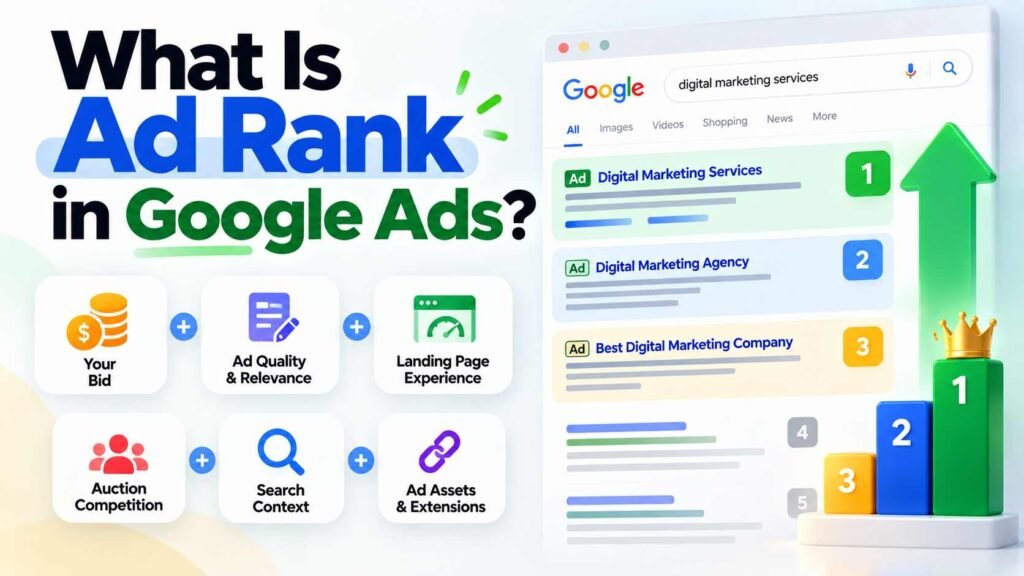
Google Ads isn’t just about who bids the most. Every search triggers an auction, and Google looks at a bunch of things-not just your bid. They check your ad quality, landing page, competition, search context, certain thresholds, and even how your ad assets might help performance.
Actually, knowing how Ad Rank works is key if you’re running search campaigns. It’s why someone can outrank you even if they bid less. If your ad and landing page are more relevant, you can get better positions and sometimes pay less.
What Is Ad Rank in Google Ads And How Does It Work?
So, Ad Rank is basically how Google decides if your ad shows up and where it appears. It’s calculated every time someone searches, so your position can change based on the search, competition, and a few other signals.
The process begins when a person enters a search query. Google identifies eligible ads that could potentially match that search. Ads that meet the necessary requirements then compete in the auction.
At a high level, Ad Rank considers six major areas:
- Your bid
- Ad and landing-page quality
- Ad Rank thresholds
- Auction competitiveness
- The context of the person’s search
- The expected impact of ad assets and other ad formats
There isn’t a fixed Ad Rank for your campaign. It changes with every auction.
Why Does Ad Rank Change?
Imagine you advertise a dental clinic. A person searches from Hyderabad on a mobile phone during the evening for a treatment-related service.
Another person searches for a similar service from a different location using a desktop computer.
Even if you don’t change your campaign or bids, the auction can play out differently each time. Google looks at things like search terms, location, device, time, and what else is showing up in the results.
That’s why your ad position can jump around instead of staying in one spot.
What Factors Affect Ad Rank?
The answer to What Is Ad Rank in Google Ads becomes much more useful when each major input is understood separately.
- Your Bid
Your bid is just the max you’re willing to pay for a click. Bidding higher can help, but it doesn’t guarantee you’ll get the top spot.
Google evaluates bids alongside other factors.
You can’t just keep raising bids forever. That’s not a real strategy.
- Ad Quality And Landing-Page Experience
Google checks if your ad and landing page are actually useful and relevant. They look at things like expected click-through rate, how relevant your ad is, and what the landing page experience is like.
For example, if someone searches for ‘SEO services for small businesses,’ your ad should talk about small business SEO and send them to a page about that-not just your homepage.
Landing-page factors can include:
- Relevance to the advertisement
- Usefulness of the page
- Ease of navigation
- Alignment between the ad and page
- Overall user experience
Businesses looking to improve the broader organic side of their website can also explore Best SEO Services in Hyderabad.
- Ad Rank Thresholds
Google applies minimum thresholds that ads need to meet to show. These thresholds can vary depending on factors such as ad quality, ad position, user attributes, and the nature of the search.
That’s why just looking at your bid versus a competitor’s doesn’t give you the full picture.
Sometimes your ad won’t show up even if there’s not much competition, just because it doesn’t meet Google’s requirements.
- Auction Competition
Your Ad Rank is evaluated against other advertisers competing for the same opportunity.
If two advertisers have similar Ad Rank values, their opportunities to win a particular position can be closer. When there is a larger gap, the advertiser with the stronger Ad Rank has a greater likelihood of securing the higher position.
Competition can also vary by query, location, device, time, and other auction conditions.
- Search Context
Search context is an important part of Google’s auction.
Google can consider:
- Search terms
- User location
- Device
- Time of search
- Nature of the search
- Other ads on the page
- Other search results
- Relevant user signals and attributes
So, Ad Rank isn’t a fixed score. It’s something that changes every time there’s an auction.
- Expected Impact Of Ad Assets
Ad assets can provide additional information such as sitelinks and other useful details. Google estimates how these assets and formats may affect ad performance when determining Ad Rank.
Adding the right assets can make your ad more useful and give people more ways to interact.
What Is The Difference Between Ad Rank And Quality Score?
One of the most common Google Ads misconceptions is treating Ad Rank and Quality Score as the same thing.
They are not.
Ad Rank is used during the ad auction to determine eligibility and position.
Quality Score is a diagnostic tool available in the Google Ads account. Google presents it on a 1-10 scale and uses components such as expected click-through rate, ad relevance, and landing-page experience to provide insight into ad quality. Google explicitly states that the Quality Score number itself is not an input into the ad auction.
This difference is important when you’re actually optimizing campaigns.
If an advertiser sees a Quality Score of 6 and focuses entirely on turning it into a 10, they may miss the bigger business questions:
- Are the keywords relevant?
- Are the ads aligned with search intent?
- Are users reaching the right landing page?
- Are campaigns generating qualified leads?
- Is the cost per acquisition sustainable?
- Are conversions being tracked correctly?
Quality Score is just a diagnostic tool. Don’t waste time chasing a perfect number-instead, focus on what actually drives results.
What About Ad Strength?
Ad Strength is another Google Ads metric that is sometimes confused with Ad Rank.
Ad Strength helps advertisers evaluate the variety and relevance of assets in responsive search ads. Google states that Ad Strength does not determine whether an ad is eligible to serve and is not used to calculate Ad Rank or Quality Score.
So the three concepts should be treated differently:
Ad Rank → Auction eligibility and position
Quality Score → Diagnostic information about ad quality
Ad Strength → Feedback on responsive search ad assets
How Can You Improve Ad Rank In Google Ads?
Knowing how Ad Rank works only matters if you use it to actually improve your campaigns.
There’s no magic trick to guarantee a top spot. Focus on what you can actually control.
Improve Keyword And Ad Relevance
Group your campaigns by tight search themes. Don’t dump unrelated keywords into the same ad group.
Make sure your ads match the language and intent of the searches you’re targeting.
If you’re running an ad for ‘Google Ads management,’ don’t send everyone to your homepage. Send them to a page about Google Ads services.
Write More Relevant Ad Copy
Your headlines and descriptions need to tell people exactly what they’ll get after clicking.
Consider:
- Matching the search intent
- Communicating a clear benefit
- Including relevant service information
- Using specific calls to action
- Avoiding vague promotional claims
Don’t just stuff keywords. Make your ad actually useful and interesting for the right people.
Improve Landing Pages
Even a great ad won’t work if your landing page makes things hard for the user.
Review:
- Mobile usability
- Page speed
- Content relevance
- Form length
- Navigation
- Trust signals
- Call-to-action visibility
- Message consistency
Whatever you promise in the ad, make sure your landing page actually delivers.
Use Relevant Ad Assets
Use sitelinks, call buttons, and other assets to give more info in your ad. Google looks at these when calculating Ad Rank.
If you’re using more than one channel, make sure your paid campaigns, landing pages, and tracking all work together. That’s how you get better results.
Monitor Actual Business Outcomes
A higher Ad Rank doesn’t always mean better business results.
You can get lots of visibility and still see poor results if your traffic isn’t relevant or your landing page doesn’t convert.
Monitor metrics such as:
- Impressions
- Click-through rate
- Actual CPC
- Conversion rate
- Cost per lead
- Cost per acquisition
- Qualified leads
- Revenue
- Return on ad spend
If you’re focused on lead generation, getting more qualified leads for less money is usually more important than just being at the top.
How Does Ad Rank Affect CPC And Ad Position?
Ad Rank matters because it affects both if your ad shows up and where it appears. Plus, the auction setup changes what you actually pay.
Google states that actual CPC is often lower than the maximum CPC bid because advertisers generally pay the minimum amount required to clear the applicable Ad Rank threshold and beat the Ad Rank of the competitor immediately below them, when applicable.
This means the amount you bid and the amount you actually pay are not necessarily identical.
Let’s say two advertisers are fighting for the same spot. If one has a better Ad Rank because of bid, quality, and context, the other can’t just raise their bid-they need to improve everything else too.
Also, higher ad positions usually have tougher requirements. Getting above the organic results isn’t as easy as just bidding more.
So, don’t just chase the top spot. Look at your costs and actual business results too.
Ready To Improve Your Google Ads Performance?
Google Ads performance is about more than increasing bids. Relevant keywords, strong ad messaging, useful landing pages, appropriate assets, accurate tracking, and disciplined optimization all play a role in building effective campaigns.
If you want to improve your paid search strategy and connect Google Ads with SEO, landing pages, content, and lead generation,
Contact us today to discuss your digital marketing requirements. Let’s create a strategy that drives visibility, leads, and sustainable business growth.
Frequently Asked Questions
- What Is Ad Rank in Google Ads And Why Is It Important?
What Is Ad Rank in Google Ads determines whether an advertisement is eligible to appear and, if eligible, where it can appear relative to other eligible ads. It is calculated dynamically during auctions using several factors.
- What Is Ad Rank in Google Ads Compared With Quality Score?
What Is Ad Rank in Google Ads is an auction-time value used for eligibility and positioning, while Quality Score is a 1-10 diagnostic tool that provides insight into ad quality. Google states that the Quality Score number itself is not an auction input.
- What Is Ad Rank in Google Ads And How Can I Improve It?
What Is Ad Rank in Google Ads can be improved indirectly by strengthening the factors you control, including bid strategy, ad relevance, landing-page experience, relevant assets, and overall campaign quality. No single change guarantees a particular position.
- What Is Ad Rank in Google Ads And Does A Higher Bid Always Win?
What Is Ad Rank in Google Ads shows why a higher bid alone does not guarantee the highest position. Google also considers ad quality, thresholds, auction competition, search context, and expected asset impact.
- What Is Ad Rank in Google Ads And Does It Affect CPC?
What Is Ad Rank in Google Ads is connected to the auction conditions that determine ad position and actual CPC. Google states that actual CPC is often less than the maximum CPC because advertisers generally pay the minimum amount required to clear relevant thresholds and compete for the position.