The keywords you pick in Google Ads decide who actually sees your ads, how well those ads match what people are searching for, and how far your budget goes. If you get this part wrong, you end up wasting money or missing out on good leads.
Actually, keyword targeting isn’t just about picking words with the highest search volume. You need to think about search intent, relevance, match types, negative keywords, competition, landing pages, and what you want people to do after they click. All of these work together.
So, knowing the different types of keywords in Google Ads is important no matter what kind of business you run-local service, e-commerce, B2B, or anything else. It’s the basics you need before you start running search campaigns.
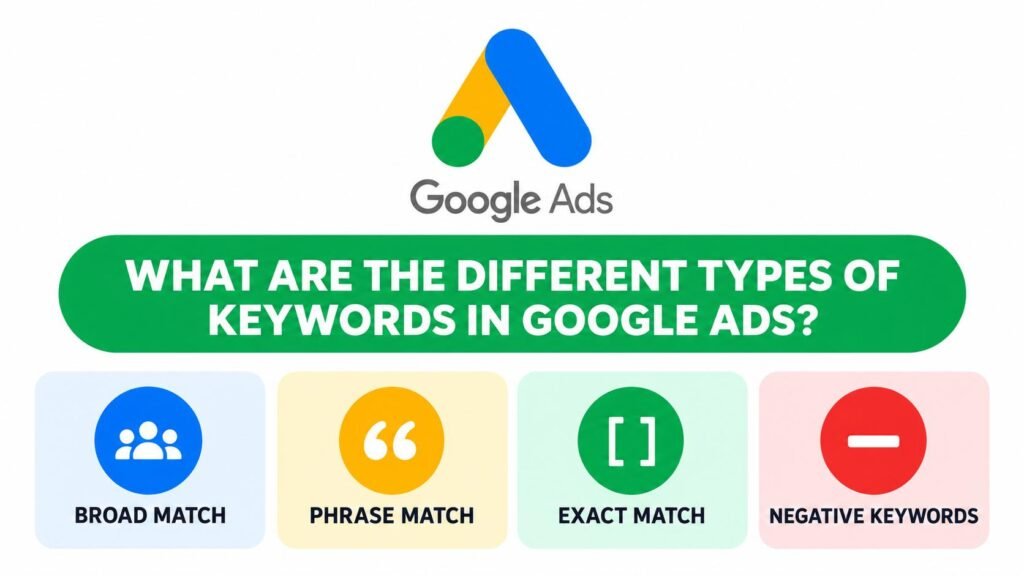
What Are The Different Types Of Keywords In Google Ads?
The main keyword match types used in Google Ads are broad match, phrase match, and exact match. Negative keywords are also important because they help prevent ads from appearing for searches that are not relevant to the business.
These keyword options control how closely a user’s search needs to relate to the keyword before an ad becomes eligible to show.
1. Broad Match Keywords
A broad match gives Google the most freedom to show your ads for related searches. It’s the widest net you can cast.
For example, if a business targets:
digital marketing agency
Google may be able to match the ad with searches that have related meanings or intent, rather than requiring the exact wording.
A broad match is good if you want to find new search terms and reach more people. But you have to watch it closely, because it can also bring in a lot of irrelevant clicks if you’re not careful.
If you already have good conversion tracking and use automated bidding, broad match can actually work well. But don’t use it blindly-make sure you’re tracking real business results, not just clicks.
2. Phrase Match Keywords
Phrase match gives you more control than broad match. Google will still match your ads to searches with extra words or slight variations, but it’s closer to what you actually want.
For example, a keyword such as:
“best digital marketing agency”
could potentially match searches such as:
- best digital marketing agency in Hyderabad
- affordable digital marketing agency
- digital marketing agency for small business
Don’t assume phrase match means the search has to include your exact phrase in the same order. Google looks at intent, so your ad might show for related searches too.
3. Exact Match Keywords
Exact match gives you the most control, but it doesn’t mean the search has to be word-for-word. Google still matches close variations if the intent is the same.
Google can match exact-match keywords to searches that share the same meaning or intent, including close variations.
For example:
[SEO services Hyderabad]
could potentially trigger for a search with the same underlying intent even when the wording differs.
Use exact match when you know which search themes bring the best results and you want to control where your budget goes.
How Do Keyword Match Types Affect Google Ads Campaigns?
The answer to What Are the Different Types of Keywords in Google Ads? becomes more useful when match types are considered as campaign controls rather than isolated keyword categories.
The three primary match types provide different levels of reach and control.
Match Type | General Approach | Common Use |
Broad Match | Wider interpretation of intent | Discovery and scale |
Phrase Match | More controlled relevance | Balanced reach and targeting |
Exact Match | Tighter intent control | Specific, valuable searches |
There is no universal match type that works for every campaign.
If you’re a local business with a small budget, focus on the most relevant searches. If you have more data and budget, you can test broader targeting to find new opportunities.
4. Search Intent Matters More Than Keyword Volume
A lot of people make the mistake of picking keywords just because they have high search volume.
A keyword with thousands of searches may generate fewer useful leads than a highly specific keyword with much lower search volume.
Consider the difference between:
- digital marketing
- digital marketing agency
- hire digital marketing agency
- best digital marketing services in Hyderabad
These searches can represent different levels of commercial intent.
If someone is just searching for general info, they’re probably still researching. If they’re looking for a specific service in a city, they’re much closer to reaching out.
That’s why you need to look at intent, relevance, competition, conversion value, and where the customer is in their buying journey-not just search volume.
5. Commercial And Transactional Keywords
Commercial keywords indicate that a person may be comparing products or services before making a decision.
Examples include:
- best SEO agency
- Google Ads agency
- website development company
- digital marketing services
- SEO consultant near me
Transactional keywords are often even more action-oriented:
- hire SEO agency
- buy running shoes online
- book dental appointment
- order office furniture
The appropriate keyword strategy depends on what the business wants the campaign to achieve.
How Do Negative Keywords Improve Google Ads Targeting?
Negative keywords are one of the most important parts of search campaign management.
They tell Google which searches should not trigger an ad based on specific terms or concepts.
For example, suppose a company sells paid digital marketing services. It may not want to appear for searches containing terms such as:
- free
- course
- jobs
- salary
- internship
- tutorial
The exact negative keyword strategy should be based on actual search-term data and campaign objectives.
6. Why Search Term Reports Matter
Keyword planning should not stop after a campaign goes live.
The Search terms report can reveal the queries that actually resulted in ad impressions and clicks. Reviewing these searches helps advertisers identify:
- Irrelevant queries
- New keyword opportunities
- Unexpected customer language
- Negative keyword opportunities
- High-value search themes
- Poorly targeted traffic
This is why managing your campaign in the real world matters more than just building a big keyword list.
You’ll often find that customers use different words than you expected. Adjust your keywords based on what real people are actually searching for.
7. Keyword Grouping And Ad Relevance
Group your keywords in a way that keeps your ads and landing pages relevant to what people are actually looking for.
For example, an agency might separate campaigns or ad groups around:
- SEO services
- Google Ads management
- Social media marketing
- Website development
- Content marketing
Each group should have ads and landing pages that match that specific theme.
Make sure your landing page delivers on what the ad promises. If you run an ad for SEO services, don’t send people to a generic homepage. Give them the info they’re looking for.
Businesses looking for digital marketing services in Hyderabad can use the same principle when evaluating how an agency structures paid search campaigns.
How Should You Choose The Right Google Ads Keywords?
There’s no one-size-fits-all formula for picking keywords. Start with your business goal, then work backward to figure out what people would search for to reach that goal.
8. Start With The Business Goal
First decide what the campaign needs to accomplish.
Is the objective:
- Lead generation?
- Online sales?
- Phone calls?
- Appointment bookings?
- Website traffic?
- Brand awareness?
- Product discovery?
If you want leads, your keyword strategy will look different than if you just want to build awareness.
9. Research Customer Language
Listen to how real customers talk about their problems. That’s where your best keywords come from.
Keyword research tools can provide ideas, but customer conversations, sales calls, website analytics, search-term reports, and existing enquiries can also reveal valuable language.
This experience-driven research often uncovers phrases that generic keyword lists miss.
10. Match Keywords With Landing Pages
Every main keyword or theme should have its own landing page.
For example:
Keyword: SEO services Hyderabad
Landing page: SEO service page
Keyword: Google Ads management Hyderabad
Landing page: PPC/Google Ads service page
This way, the customer’s journey from search to ad to landing page actually makes sense.
For businesses investing in SEO services, the same principle applies to organic search: the page should satisfy the intent behind the query rather than simply repeat the keyword.
What Are Common Google Ads Keyword Mistakes?
Just knowing the types of keywords isn’t enough. If you don’t manage them well, your campaign won’t perform.
Common mistakes include:
Using Too Many Broad Keywords
If you add hundreds of broad keywords without tracking conversions or monitoring results, you’ll have no idea where your budget is going.
Ignoring Negative Keywords
If you don’t check your search-term reports, you’ll keep paying for clicks that don’t bring any real value.
Targeting Keywords With No Business Relevance
Just because a keyword has high search volume doesn’t mean it’s right for your business.
Sending Every Ad To The Homepage
Different search intents usually deserve different landing pages.
Focusing Only On Clicks
Clicks are just the start. What really matters is lead quality, sales, appointments, revenue, and actual conversions.
If you’re judging a marketing agency, look at how they measure results-not just clicks, but real business outcomes.
Final Thoughts
Google Ads isn’t about stuffing in as many keywords as you can. It’s about knowing what your customers are searching for and connecting those searches to the right ads, landing pages, and business results.
Broad, phrase, and exact match each have a role, while negative keywords help protect campaigns from irrelevant traffic. Search-term analysis then provides real-world evidence that can be used to refine targeting over time.
If you’re looking for digital marketing services in Hyderabad, don’t just go by promises of clicks or rankings. Find an agency that understands your business goals, your customers, and how to actually improve your campaigns with data.
Ready To Build A More Effective Google Ads Strategy?
Contact us today to discuss your advertising goals and build a data-driven strategy around relevant search intent, stronger landing pages, and measurable business outcomes.
FAQs
1. What Are The Different Types Of Keywords In Google Ads For Beginners?
What Are the Different Types of Keywords in Google Ads? For beginners, the main match types to understand are broad match, phrase match, and exact match. Negative keywords are also essential for excluding irrelevant searches.
2. What Are The Different Types Of Keywords In Google Ads Used For Lead Generation?
What Are the Different Types of Keywords in Google Ads? For lead generation, advertisers often combine relevant commercial or transactional search themes with appropriate match types and negative keywords to focus budget on potential customers.
3. What Are The Different Types Of Keywords In Google Ads And Which One Should I Use?
What Are the Different Types of Keywords in Google Ads? include broad, phrase, and exact match. The right combination depends on the campaign objective, conversion data, budget, audience, and desired level of targeting control.
4. What Are The Different Types Of Keywords In Google Ads For Local Businesses?
What Are the Different Types of Keywords in Google Ads? can include broad, phrase, and exact match keywords built around services, locations, and customer intent. Negative keywords can further reduce irrelevant local traffic.
5. What Are The Different Types Of Keywords In Google Ads And Why Do They Matter?
What Are the Different Types of Keywords in Google Ads? matter because match types influence how Google interprets searches against your targeting. Choosing and monitoring them carefully can help improve relevance and control advertising spend.