
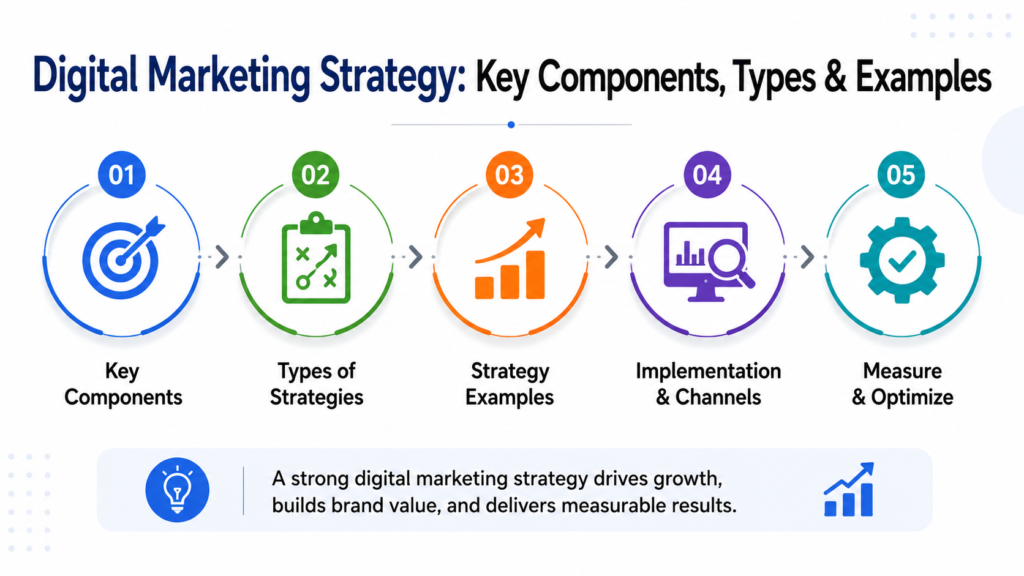
So, even if you have a solid product, a nice-looking website, and you’re posting on social media, you might still not see steady results. Usually, it’s not because you’re not doing enough marketing. It’s because all those efforts aren’t connected by a clear direction.
Actually, a proper digital marketing strategy is what turns random campaigns into a system that drives growth. It gets specific about who you’re targeting, what you want to achieve, which channels make sense, what you should say, and how you’ll track if it’s working.
Your strategy should match how people actually buy. Someone seeing your brand for the first time needs different info than someone comparing you to a competitor or someone ready to buy now.
If you know the main parts and types of strategies, you can build a plan that actually fits your business instead of just copying some generic marketing template.
What Is A Digital Marketing Strategy?
A digital marketing strategy is a structured plan for using online channels to achieve your business goals. With the Best Digital Marketing Services in Hyderabad, businesses can develop focused strategies across SEO, paid advertising, social media, content marketing, and lead generation to support sustainable growth.
Those objectives could include:
- Generating qualified leads
- Increasing online sales
- Building brand awareness
- Improving search visibility
- Increasing customer retention
- Entering a new market
- Promoting a new product or service
The strategy connects your goals to the right audience, channels, messaging, content, offers, budgets, and what you’ll measure.
For example, a local service business might focus on SEO, Google Ads, Google Business Profile optimization, social media, and WhatsApp enquiries. An e-commerce company may place greater emphasis on paid social campaigns, search advertising, email marketing, product content, remarketing, and retention.
There’s no one-size-fits-all structure. Your strategy should match your market, how your customers buy, your sales cycle, resources, and business model.
Key Components Of A Digital Marketing Strategy
1. Business Goals
Start every marketing plan with your main business goal.
Don’t just say ‘increase website traffic.’ Be clear about what you want that traffic to do.
For example:
Business Goal: Increase qualified enquiries
Marketing Goal: Generate relevant website leads
Measurement: Qualified enquiries and conversion rate
This way, your marketing stays tied to real business results.
2. Target Audience
You need to know your audience so you can decide what to say, where to say it, and what kind of offer makes sense.
Look at what your customers need, what problems they have, why they buy, what might stop them, where they are, how they search, and how they like to communicate.
A business serving corporate decision-makers may require a completely different approach from a company selling directly to consumers.
3. Competitor Research
Competitor analysis: Check out how your competitors are positioning themselves.
- Website
- Search visibility
- Offers
- Content
- Advertising
- Reviews
- Social media
- Customer experience
Don’t just copy what others are doing. Look for gaps you can fill.
4. Positioning And Messaging
Give customers a clear reason to choose you.
Your positioning should explain what you offer, who it’s for, and why your approach matters or stands out.
Strong messaging can then be adapted across website pages, advertisements, social media, email campaigns, landing pages, and sales conversations.
5. Channel Selection
A business You don’t need to be on every digital platform. channels based on customer behaviour and business objectives.
Common channels include:
- SEO
- Google Ads
- Social media
- Content marketing
- Email marketing
- Video marketing
- Remarketing
The best mix depends on where your customers actually search, compare, and decide.
6. Content Strategy
Every piece of content should have a clear purpose.
A useful and good content strategy answers your customers’ questions at each stage of their buying journey.
Awareness: What is the problem?
Consideration: What solutions are available?
Decision: Why should I choose this business?
Retention: How can I get more value after purchasing?
This way, your content actually helps people move through the buying process, not just fill up your posting schedule.
7. Conversion Strategy
Getting traffic is just one part of digital marketing.
You need to show visitors exactly what to do next.
Depending on the business, that action could be:
- Submit an enquiry
- Request a quotation
- Book a consultation
- Download a guide
- Add a product to cart
- Make a purchase
- Contact the business on WhatsApp
Your landing pages, forms, offers, calls to action, and follow-up should all work together to make the next step easy.
8. Measurement And Analytics
Decide how you’ll measure success before you launch any campaigns.
Depending on the objective, useful metrics may include:
- Qualified leads
- Conversion rate
- Customer acquisition cost
- Organic traffic
- Search rankings
- Revenue
- Average order value
- Return on advertising spend
- Repeat purchases
Not every metric matters. Focus on KPIs that actually show if your marketing is helping you reach your business goals.
Types Of Digital Marketing Strategies
1. SEO Strategy
An SEO strategy focuses on improving organic visibility for relevant searches.
It can include keyword research, technical optimization, content development, internal linking, local SEO, and authority building.
SEO works best if your customers are already searching for your products, services, answers, or local providers.
2. Paid Advertising Strategy
Paid advertising uses platforms such as Google Ads and social advertising to reach selected audiences.
A strong paid strategy includes audience targeting, campaign structure, creative testing, landing pages, conversion tracking, budget management, and optimization.
Paid campaigns are great if you want to test offers, create demand, or capture people who are already searching.
3. Social Media Strategy
Social media can support awareness, engagement, credibility, and customer relationships.
A strategy may include educational content, short-form videos, customer stories, expert content, product demonstrations, community engagement, and paid social advertising.
The goal should be linked to a business objective rather than simply increasing follower numbers.
4. Content Marketing Strategy
Content marketing uses useful information to attract and educate potential customers.
Blogs, guides, videos, case studies, newsletters, and social posts can all support this approach.
Content is most valuable when your customers need info before they’re ready to buy.
5. Email And Retention Strategy
Digital marketing should not stop after the first conversion.
Email can support:
- Lead nurturing
- Product education
- Offers
- New launches
- Customer retention
- Repeat purchases
A good retention strategy helps you get more value from your current customers, so you’re not always chasing new ones.
6. Local Marketing Strategy
Businesses serving a specific geographic area can build their strategy around local visibility.
This can include Google Business Profile optimization, local landing pages, location-focused content, reviews, local search campaigns, and location-specific offers.
If you’re targeting Hyderabad, for example, showing up in local search is usually more valuable than trying to rank for every keyword across India.
Practical Examples Of Digital Marketing Strategies
Example 1: Local Service Business
A local service provider wants more qualified enquiries.
Its strategy could be
Local SEO → Google Ads → Service Landing Page → WhatsApp/Call → Sales Follow-Up
SEO gives you long-term visibility. Paid search brings in leads right away. The landing page explains your offer, and your conversion process moves people into your sales pipeline.
Example 2: E-Commerce Business
An online retailer launching a new product could use:
Social Media → Product Page → Offer → Add To Cart → Checkout → Email Follow-Up → Repeat Purchase
This approach covers awareness, conversion, and retention. Don’t just stop at the product ad-think about the whole customer journey.
Example 3: B2B Company
A B2B business with a longer sales cycle might use:
SEO Content → LinkedIn → Industry Guide → Lead Form → Email Nurturing → Sales Consultation
In B2B, customers usually want a lot of info before they talk to sales. So, your strategy should focus more on content and nurturing.
These examples show why you need to adapt your strategy to your own buying journey, not just copy what someone else is doing.
How To Build An Effective Strategy
Here’s a simple process you can follow:
Step 1: Define business objectives.
Step 2: Research your target audience.
Step 3: Analyze competitors and market opportunities.
Step 4: Establish your positioning and key messages.
Step 5: Select the most relevant marketing channels.
Step 6: Plan content and offers for each customer stage.
Step 7: Build landing pages and conversion paths.
Step 8: Set budgets, responsibilities, and timelines.
Step 9: Configure analytics and conversion tracking.
Step 10: Review performance and optimize continuously.
This stops you from jumping straight into execution without knowing what you’re actually trying to achieve.
Common Mistakes To Avoid
Even the best strategy can fail if you don’t execute it well.
Avoid:
- Choosing channels without audience research
- Focusing only on traffic or followers
- Using the same message for every customer
- Sending all advertising traffic to the homepage
- Ignoring lead follow-up
- Running campaigns without conversion tracking
- Changing strategy before enough data is available
- Treating SEO, content, advertising, and social media as completely separate activities
Your strategy should connect all these activities so they work together.
Final Thoughts
A successful marketing strategy isn’t just a list of platforms. It’s a plan that shows where you want to go, who you want to reach, how you’ll reach them, what you’ll offer, and how you’ll measure results. Strategy types and examples discussed above provide a foundation for making those decisions.
If you take the time to understand your audience, pick the right channels, create real offers, build clear conversion paths, and track what matters, you’ll make better marketing decisions. Strategy is not necessarily the one with the most campaigns. It is the one where each activity has a clear role in moving the customer and the business toward the desired outcome.
Ready To Build A More Focused Marketing Strategy?
If your marketing feels all over the place or you’re not sure which channels to focus on, let’s talk. At SpaceKey Digital, we help you build a clear plan based on your business goals, audience, and what actually drives growth.
Reach out today to discuss a strategy that’s built around real, measurable business results.
FAQs
1. What is the main purpose of a digital marketing strategy?
The main purpose is to connect business objectives with the right audiences, channels, messages, offers, and measurable marketing activities.
2. What are the most important components of a digital marketing strategy?
The core components include business goals, audience research, competitor analysis, positioning, channel selection, content, conversion planning, budgets, and performance measurement.
3. Which type of strategy is best for a small business?
There is no universal answer. A small business should prioritize the channels most closely connected to its customers, location, buying behaviour, objectives, and available resources.
4. How often should a digital marketing strategy be reviewed?
Campaign performance can be monitored regularly, while the broader strategy can be reviewed monthly or quarterly. Major changes in the market or business may require an earlier review.
5. How can a business know whether its strategy is working?
Track KPIs connected to the actual business objective. Depending on the goal, this could include qualified leads, sales, revenue, customer acquisition cost, conversion rates, organic traffic, or repeat purchases.