
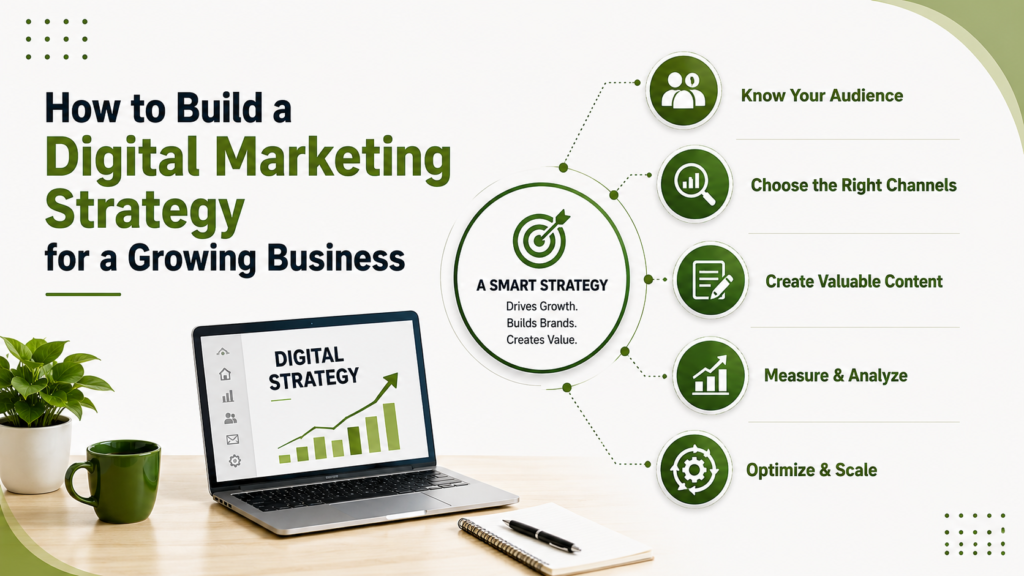
So, if your business is growing, just posting on social media now and then or running ads when sales dip isn’t going to cut it anymore. You need a plan, clear priorities, and a way to actually track if your marketing is helping you grow.
Actually, this is where a proper digital marketing strategy makes sense. It’s not about running SEO, ads, social media, content, email, and website as separate things. You need to connect them so they work together as one system for getting customers.
The strategy you use should change as your business grows. If you’re just starting out, focus on awareness and getting leads. Once you’re established, shift to retention, expanding into new markets, automating processes, and making sure you’re profitable.
What Should a Digital Marketing Strategy Include?
Don’t start with platforms or tools. Start with what your business actually wants to achieve. Figure that out before you decide where to spend your budget.
1. Set Clear Business Goals
Your marketing goals should connect directly with commercial objectives.
Depending on the business, these might include:
Increasing qualified leads
Growing online sales
Improving brand awareness
Entering a new market
Increasing website enquiries
Generating repeat purchases
Reducing customer acquisition costs
Skip vague goals like “get more followers.” Instead, set targets like “get 100 qualified enquiries per month” or “increase organic leads from Hyderabad.”
When your goals are specific, it’s much easier to know what to focus on.
2. Understand Your Ideal Customer
Your marketing works better when you actually know who you’re trying to reach.
Study:
Customer demographics
Location
Buying behavior
Problems and needs
Search behavior
Preferred communication channels
Common objections
Purchase decision factors
Talk to your customers and sales team. You’ll get insights and questions that you won’t find in analytics.
How Do You Choose the Right Digital Marketing Channels?
Not every business needs every platform.
Pick your channels based on how your customers behave and what your business needs right now.
Search Engine Optimization
SEO can help businesses attract people who are already searching for relevant solutions.
A long-term SEO plan may include technical optimization, keyword research, useful content, internal linking, local search, and ongoing performance analysis.
SEO can be particularly valuable for businesSEO is useful if you want steady organic visibility and don’t want to rely only on paid traffic. vide faster access to targeted audiences.
Potential channels include:
Google Ads
Meta Ads
YouTube Ads
LinkedIn Ads
Display advertising
Remarketing
Choose your campaigns based on who you’re targeting, what you’re selling, your sales cycle, and what action you want people to take.
Social Media Marketing
Social media is good for building awareness, showing expertise, engaging people, and getting leads.
The strategy should define:
Which platforms matter
What content will be published
How often content will be created
Which audiences will be targeted
How social activity will support business goals
Just posting a lot doesn’t mean you’ll get results.
Content Marketing
Content can support almost every stage of the customer journey.
Useful content formats include:
Blog posts
Service pages
Guides
Case studies
FAQs
Videos
Email content
Downloadable resources
The best content actually answers real customer questions and fits into your overall marketing plan.
How Does a Website Fit Into the Strategy?
Your website is often the central destination for digital traffic.
People may discover your business through Google, social media, paid advertising, email, or referrals. The website then helps them decide whether to trust the business and take action.
A strategy should therefore review:
Website Experience
Is the site easy to navigate?
Mobile Usability
Can visitors comfortably use it on smartphones?
Page Speed
Do important pages load efficiently?
Conversion Paths
Can visitors quickly call, enquire, book, purchase, or contact the business?
Content Quality
Does each important page answer the questions customers actually have?
That’s why your digital marketing and website strategy should go together. Ads and SEO bring people in, but your website has to turn that attention into real actions.
How Should You Build a Content Strategy?
Don’t just publish random topics. Plan your content based on what your customers actually want or need.
A useful approach is to create three levels of content.
Awareness Content
This answers broad questions and introduces the audience to a problem or opportunity.
Examples:
Industry guides
Educational articles
Trend analysis
Beginner resources
Consideration Content
This helps people compare solutions.
Examples:
Service comparisons
Buying guides
Case studies
Product comparisons
FAQs
Decision Content
This supports people who are close to becoming customers.
Examples:
Service pages
Pricing information
Testimonials
Product pages
Consultation pages
This setup helps your content guide customers from their first touchpoint all the way to becoming a lead or sale.
How Should a Growing Business Use Data?
Use data to make decisions at every stage.
Important metrics may include:
Organic traffic
Qualified leads
Conversion rate
Cost per lead
Customer acquisition cost
Return on ad spend
Website enquiries
Sales revenue
Customer retention
For example:
Are we attracting the right audience?
Look at qualified traffic and lead quality.
Are campaigns profitable?
Review acquisition cost and revenue.
Is SEO improving?
Monitor search visibility, organic traffic, conversions, and relevant keyword growth.
How Do You Create a Realistic Marketing Budget?
Don’t just split your marketing budget across every channel. Allocate based on what matters most for your business right now.
Start by identifying the channels that are most likely to influence your target audience.
For example:
A local service business might prioritize SEO, Google Ads, and Google Business Profile optimization.
An e-commerce company may focus on paid social, Google Shopping, SEO, email, and remarketing.
A B2B manufacturer might place greater emphasis on SEO, LinkedIn, content, and lead nurturing.
Leave some budget for testing. Not every campaign will work perfectly from the start.
Treat testing as part of your investment, not as a failure.
How Should You Turn Leads Into Customers?
Getting leads is just one step in the process.
You need to plan what happens after someone submits an enquiry.
Businesses can improve this stage through:
Faster response times
CRM systems
WhatsApp automation
Email follow-up
Lead qualification
Remarketing
Sales team coordination
If you get a lead from Google Ads, don’t let it sit in your inbox for two days. Quick follow-up matters, especially when customers are checking out multiple options.
This is where marketing and sales need to work together.
How Often Should You Review Your Strategy?
A growing business should not create a strategy once and leave it untouched.
Review performance regularly and make larger strategic adjustments at planned intervals.
A monthly review can examine:
Campaign performance
Content results
SEO movement
Lead quality
Budget allocation
Conversion rates
A quarterly review can look at bigger questions:
Which channels are growing?
Which activities should be reduced?
Which products or services deserve more promotion?
Has the target audience changed?
Are new competitors entering the market?
Should the business expand into new locations?
Continuous review helps keep the Online Marketing Strategy aligned with business conditions.
Common Mistakes to Avoid
Many businesses struggle because they start executing before building a clear plan.
Common problems include:
Trying every social platform
Running ads without conversion tracking
Publishing content without understanding search intent
Focusing on traffic instead of qualified leads
Changing strategies too frequently
Ignoring the website experience
Using the same message for every audience
Failing to connect marketing with sales
A strong strategy does not need to be complicated. It needs to be focused.
A Simple Framework for Building Your Strategy
You can think of a practical Digital Marketing Strategy as six connected steps:
1. Research
Understand your market, customers, competitors, and current performance.
2. Define Goals
Set measurable business and marketing objectives.
3. Select Channels
Choose SEO, paid advertising, social media, content, email, or other channels based on the customer journey.
4. Build Assets
Improve your website, landing pages, content, creative, and tracking.
5. Launch and Measure
Start campaigns and monitor meaningful KPIs.
6. Optimize and Scale
Invest more in what works, fix weak points, and continuously improve performance.
This framework gives growing businesses a practical way to organize their marketing without losing sight of the bigger picture.
Conclusion
A growing business does not need more marketing activity for the sake of activity. It needs a clear system that connects audience research, content, SEO, advertising, social media, website experience, lead management, and measurement.
The most effective Digital Marketing Strategy is one that reflects your current business position while leaving room to scale.
Start with clear goals. Understand your customers. Choose channels based on evidence. Measure meaningful outcomes. Then improve the strategy as new data becomes available.
That process helps marketing become more predictable, focused, and closely connected to business growth.
Ready to turn your marketing activities into a structured growth strategy?
Reach out today to discuss your business goals and build a customized digital marketing strategy focused on increasing visibility and leads, improving conversions, and achieving sustainable growth.
FAQs
1. What is a Digital Marketing Strategy?
A Digital Marketing Strategy is a structured plan that connects online marketing activities with specific business objectives. It defines the audience, channels, content, budget, KPIs, and optimization process.
2. Which Digital Marketing Services does a growing business need?
The right Digital Marketing Services depend on your goals, industry, audience, and budget. SEO, paid advertising, social media, content marketing, website optimization, and lead generation are common components.
3. How long does an Online Marketing Strategy take to show results?
An Online Marketing Strategy can produce different results at different speeds. Paid advertising can generate traffic quickly, while SEO, content, and brand-building activities generally require more time and consistent effort.
4. How much should a business spend on digital marketing?
There is no universal budget. Your Digital Marketing Strategy should determine investment based on customer value, competition, sales goals, available resources, and the channels most likely to produce results.
5. Can one agency manage all Digital Marketing Services?
Yes, a full-service agency can coordinate multiple Digital Marketing Services under one strategy. The important consideration is whether the agency understands your business and can connect the channels effectively.