
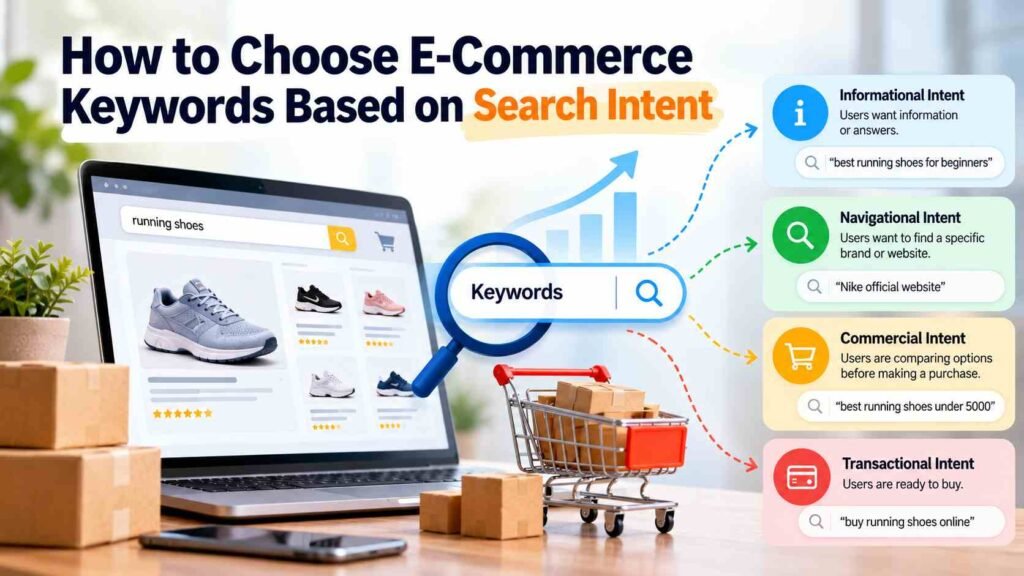
Even if your online store has great products, good prices, and a nice-looking website, you might still not get the right shoppers. Usually, it’s because your product pages are targeting keywords without thinking about what people are actually looking for.
Someone searching for “best running shoes for beginners” is researching options, while a person searching for “buy running shoes size 9” is closer to making a purchase. Although both searches relate to the same product category, their expectations are different.
Actually, if you understand how to pick e-commerce keywords based on search intent, you can match your product pages, categories, and guides to what shoppers really need. Don’t just chase search volume. Build a keyword strategy that brings in the right visitors and actually supports the full customer journey.
What Is Search Intent in E-Commerce SEO?
Search intent is basically why someone is searching in the first place. Are they looking for info, comparing products, trying to find a specific site, or ready to buy right now? Figuring this out helps you pick the right keywords and decide which pages should show up in search.
For e-commerce websites, the main search intent categories are informational, commercial investigation, transactional, and navigational.
- Informational Intent: When Shoppers Need Answers
Informational searches happen when people want to learn something before making a decision. Examples include “how to choose a mattress,” “how to clean leather shoes,” and “what size laptop do I need?”
These searches are often best served by blog posts, buying guides, comparison explainers, and educational content. A mattress store, for instance, could publish a guide explaining firmness levels and sleeping positions, then link naturally to relevant mattress categories.
- Commercial Investigation: When Buyers Compare Options
Commercial searches suggest that users are evaluating products before purchasing. They may search for “best wireless headphones under ₹5,000,” “Brand A vs Brand B,” or “waterproof hiking shoes reviews.”
Comparison articles, curated collections, detailed product pages, and buying guides work well here. Focus on real differences, specs, limitations, and who each product is for. Don’t just throw in generic claims.
- Transactional Intent: When Shoppers Are Ready to Buy
Transactional queries indicate a stronger likelihood of purchase. Examples include “buy office chair online,” “order cotton bedsheets,” and “running shoes size 9 price.”
For these searches, your product and category pages should do the job. Make sure you show accurate prices, stock status, delivery info, and return policies, and make it easy for people to buy.
- Navigational Intent: When Users Seek a Specific Brand or Page
Navigational searches include a brand or website name, such as a shopper looking for a particular retailer’s login page or a specific product collection. These queries are best supported by accessible brand pages, clear navigation, and correctly indexed product or category pages.
One thing to keep in mind: sometimes a single keyword can have mixed intent. Always check the actual search results to see what types of pages Google is showing. That tells you what people expect.
How to Research and Group E-Commerce Keywords
A solid keyword strategy isn’t just about search data. You need to mix in customer language, product knowledge, and what your competitors are doing. The idea is to find the right queries and map them to the best page on your site.
- Start With Products, Categories, and Customer Questions
Start by listing your main product categories, individual products, brands, materials, features, and use cases. Then think about the questions your customers usually ask before they buy.
For example, an online skincare store might identify searches around skin type, ingredients, product size, usage instructions, and price. A furniture retailer might focus on dimensions, materials, room size, assembly, and durability.
Don’t ignore customer support chats, product reviews, sales enquiries, or your own website search logs. These often show real phrases and questions that keyword tools miss.
- Use Keyword Research Tools to Find Opportunities
Use tools like Google Keyword Planner, Search Console, and any good SEO platform to find search terms, see demand, check your current performance, and spot related queries.
Don’t just pick keywords based on search volume. Look at a few key metrics:
- Search volume: How frequently a keyword is estimated to be searched.
- Keyword relevance: How closely the query matches your products and audience.
- Competition: How difficult it may be to compete for the search.
- Commercial value: Whether the query aligns with your business model and product margins.
- Current performance: Whether your website already receives impressions or clicks for the term.
Remember, search volume is just an estimate. Sometimes a low-volume keyword brings in better leads than a broad, high-volume one.
- Analyze Search Results Before Choosing a Page Type
Search your target keyword and see what actually shows up. Are you seeing mostly product listings, category pages, guides, comparisons, or brand sites?This gives you real clues about what content format works for that keyword. For example, if ‘best office chairs for back support’ mostly shows comparison guides, just listing products won’t cut it.
Keep in mind, search results change based on location, device, and even time. Use them as a guide, not a strict rule.
- Group Keywords by Intent and Topic
Organize related keywords into clusters and assign each cluster to a suitable page. For instance, “buy ceramic coffee mugs,” “ceramic coffee mugs online,” and “ceramic mugs price” may fit one relevant category page if the products and results align.
Meanwhile, “how to choose a coffee mug” may deserve an informational article.
This way, you avoid having multiple pages fighting for the same keyword. One strong page is usually better than a bunch of weak ones.
How to Map Search Intent to Product and Category Pages
Once you’ve grouped your keywords, focus on building or improving pages that actually match what people are looking for.
- Optimize Product Pages for Purchase Decisions
A product page should help shoppers understand exactly what they are buying. Include a clear product name, accurate specifications, price, available variants, original product images, stock status, and useful delivery and return information.
Use real, descriptive language in your titles, headings, product descriptions, and image alt text. Don’t just copy-paste manufacturer descriptions. Explain the product in your own words.
Where appropriate, use valid structured data to help search engines understand product information. Ensure that marked-up prices, availability, and review details accurately match the visible page.
- Build Category Pages Around Broader Shopping Needs
Category pages are for broader product groups like ‘men’s running shoes,’ ‘wooden dining tables,’ or ‘wireless keyboards.’ Make it easy for people to browse with good filters, clear descriptions, and simple navigation.
Avoid filling category pages with repetitive paragraphs written solely to include keywords. Content should help shoppers compare options and find the right products.
- Create Buying Guides for Research-Stage Searches
Informational and commercial-investigation keywords often work well with guides that explain features, buying criteria, product differences, and common mistakes.
For example, a retailer selling laptops could publish a guide to choosing a laptop for college students. The article could explain RAM, storage, battery life, and portability, then link to relevant laptop categories.
Internal links should actually help people take the next step, not just break up your content. If you want to see how keyword research, page optimization, and content planning fit into a bigger SEO strategy, that’s something we help with at SpaceKey Digital.
- Improve Internal Linking and Avoid Keyword Cannibalization
Internal links help shoppers move between guides, categories, and products. They also help search engines discover relationships between pages.
Use anchor text that actually tells people what they’ll get. For example, link from a buying guide about office chairs directly to your office chair category, not just with a ‘click here.’
Check if you have pages targeting the same keywords. If two pages do almost the same thing, decide if you should merge them or make them different. Don’t just combine pages without checking their intent, content, traffic, and business value.
How to Measure and Improve Your E-Commerce Keyword Strategy
Keyword research should continue after publication. Monitor whether the pages you created attract relevant searches and help users progress toward a purchase.
Google Search Console can show which queries generate impressions and clicks, while analytics and e-commerce reporting can help evaluate engagement and sales when tracking is configured correctly.
Useful indicators include:
- Organic impressions and clicks for target keyword groups.
- Click-through rate from search results.
- Organic product and category page visits.
- Add-to-cart and checkout activity.
- Organic revenue and conversion rate, where attribution is available.
- Search terms that attract traffic but do not match the products offered.
For example, if your category page is getting impressions for a transactional keyword but not many clicks, check if your title actually tells people what they’ll find. If people click but don’t add to cart, look at your pricing, product info, stock, page usability, and shipping costs.
Avoid judging the strategy by rankings alone. Search position is one signal, but relevant traffic, customer experience, and business outcomes provide a more complete picture.
Businesses that need support across search, content, advertising, and website improvements can explore Best Digital Marketing Services in Hyderabad. A coordinated approach can help align keyword targeting with the wider customer journey.
If your store needs technical or structural changes, consider website development support. But don’t assume you need a full redesign. Prioritize based on what your site actually needs.
At the end of the day, choosing e-commerce keywords based on search intent is about knowing what shoppers need at each step and giving them the right page when they need it. If you get this right, you’ll make it easier for people to find your products and bring in more relevant organic traffic.
Conclusion
So, good e-commerce SEO isn’t about stuffing as many keywords as you can onto a page. It’s about knowing why people search, what info they need, and which page actually helps them take the next step.
Classify keywords by intent, validate them against search results, organize them into relevant groups, and map them to product pages, category pages, or buying guides. Then measure results using both search performance and business outcomes.
Ready to improve your e-commerce SEO strategy?
Contact SpaceKey Digital to discuss keyword research, search intent mapping, and practical ways to strengthen your website’s organic visibility.
Frequently Asked Questions
- Why Is Search Intent Important for E-Commerce Keywords?
Search intent helps retailers understand what users expect from a search. When choosing e-commerce keywords based on search intent, match informational queries to useful guides, comparison queries to evaluation content, and purchase-focused queries to relevant product or category pages.
- How Do I Find Keywords for an Online Store?
Start with your products, categories, customer questions, and search data. To choose e-commerce keywords based on search intent, use keyword research tools, review search results, and group similar queries according to the page type that best meets the shopper’s needs.
- Should Product Pages Target Informational Keywords?
Usually, product pages should prioritize queries related to a specific product and purchase decision. When choosing e-commerce keywords based on search intent, use separate guides for broad educational questions unless the product page genuinely answers that question better than other formats.
- How Many Keywords Should an E-Commerce Page Target?
There is no fixed number that suits every page. When choosing e-commerce keywords based on search intent, focus on one primary topic and closely related terms that fit naturally. Avoid adding unrelated keywords simply to increase keyword coverage.
- How Often Should I Review E-Commerce Keywords?
Review performance regularly and whenever products, customer demand, or search behaviour changes. To choose e-commerce keywords based on search intent effectively, use Search Console and analytics data to identify new opportunities, weak-performing pages, and changing shopper needs.