
Digital marketing isn’t just about posting on social or running a few Google Ads. It’s about bringing together different activities that actually help you reach the right people, build trust, get leads, and grow your business.
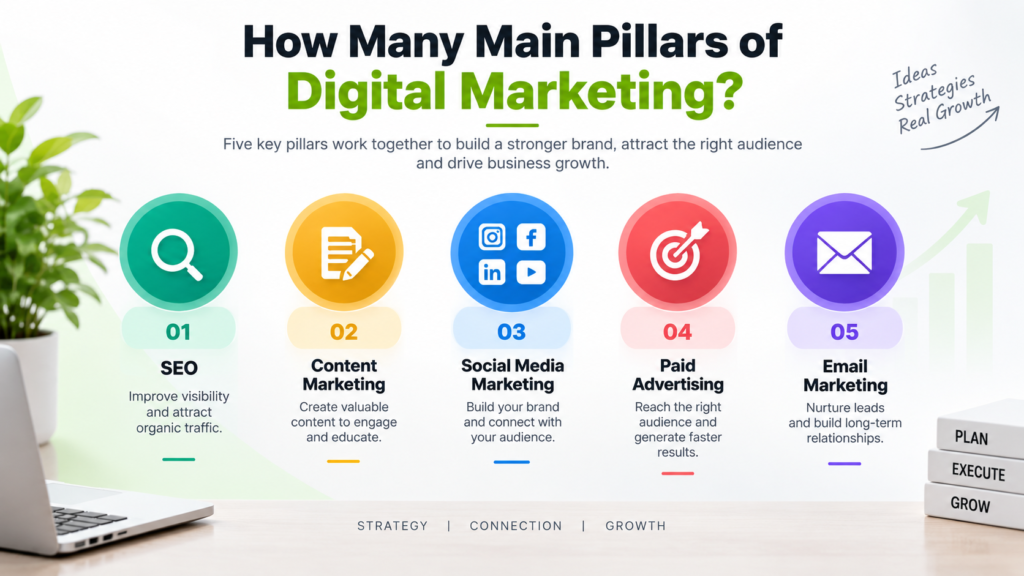
Actually, there isn’t a fixed number of digital marketing pillars. Different people group things in different ways. But if you want a practical framework, focus on these five: SEO, content marketing, social media marketing, paid ads, and email marketing. Analytics and conversion optimization are like the glue that hold everything together.
If you understand these pillars, you won’t end up relying on just one channel. That’s how you build a balanced marketing strategy.
What Are the Main Pillars of Digital Marketing?
The five main pillars of digital marketing are:
- Search Engine Optimization (SEO)
- Content Marketing
- Social Media Marketing
- Paid Advertising
- Email Marketing
Analytics, conversion optimization, website experience, and automation are also important. They support everything else and help you scale.
Each pillar does something different in the customer journey. But they work best when you connect them instead of treating them separately.
1. How Does SEO Support Digital Marketing?
Search Engine Optimization (SEO) helps a website become more visible when people search for relevant products, services, information, or businesses on search engines.
SEO focuses on improving different aspects of a website, including:
- Keyword targeting
- Search intent
- Website structure
- On-page optimization
- Technical SEO
- Content quality
- Internal linking
- Local SEO
- Backlink development
- Page experience
For example, a Hyderabad-based healthcare business may want to appear when potential customers search for relevant healthcare services nearby. Local SEO, useful service pages, Google Business Profile optimization, and relevant content can contribute to that visibility. SEO is a long-term game. You’re not paying for every click. You’re building organic visibility that lasts. If you want to improve your search presence, let’s talk about how we can help.
2. Why Is Content Marketing a Digital Marketing Pillar?
Content marketing focuses on creating useful information that attracts and helps a specific audience.
Content can take many forms, including:
- Blog articles
- Videos
- Social media posts
- Case studies
- Guides
- Infographics
- Webinars
- Podcasts
- E-books
- Landing page content
Content should always have a purpose. If you’re trying to attract people, create educational content. If they’re comparing options, give them something to help with that. If they’re ready to buy, show them what you offer.
Content also supports other marketing channels.
For example, one blog post can help you rank on Google, become a social media post, an email, a video, or even a guide. Repurpose as much as possible.
That’s why content is one of the things that connects your whole digital marketing system.
If you want to see how content can work with SEO and lead generation, reach out and I’ll walk you through it.
3. How Does Social Media Marketing Help Businesses?
Social media marketing uses platforms such as Instagram, Facebook, LinkedIn, YouTube, and other relevant channels to communicate with an audience. The goal isn’t just to collect followers.
A well-planned social media strategy can help businesses:
- Increase brand awareness
- Educate potential customers
- Showcase products or services
- Build credibility
- Generate enquiries
- Encourage website visits
- Maintain customer relationships
- Distribute valuable content
The right platform depends on the audience and business model.
For example, LinkedIn may be particularly relevant for B2B businesses, while Instagram and Facebook may be useful for consumer-facing brands. YouTube can support businesses that rely heavily on educational, demonstration, or video content.
Pick your platforms based on where your audience actually spends time. Don’t try to be everywhere.
4. Why Is Paid Advertising Important?
Paid advertising allows businesses to reach specific audiences through advertising platforms.
Common digital advertising channels include:
- Google Search Ads
- Google Display Ads
- YouTube Ads
- Meta Ads
- LinkedIn Ads
- Remarketing campaigns
- Shopping campaigns
Paid ads are useful when you need results fast or want to target a specific group.
For example, if you’re launching something new, run search ads to get in front of people right away while your SEO builds up.
However, paid campaigns require continuous attention to:
- Targeting
- Ad messaging
- Keywords
- Landing pages
- Budget allocation
- Conversion tracking
- Cost per lead
- Return on advertising spend
Running ads without tracking conversions can make it difficult to understand whether the campaign is actually contributing to business objectives.
5. How Does Email Marketing Fit Into Digital Marketing?
Email marketing focuses on communicating directly with people who have already interacted with a business or voluntarily provided their contact information.
Businesses can use email for:
- Newsletters
- Product updates
- Offers
- Educational content
- Lead nurturing
- Customer onboarding
- Event invitations
- Follow-ups
- Retention campaigns
Email is especially useful when your sales cycle is long and people take time to decide.
For example, someone may download a guide today but not purchase a service immediately. A relevant email sequence can provide additional information and keep the business connected with that potential customer.
Don’t just send promotions for the sake of it. Make sure your emails are actually useful to the person receiving them.
Is Analytics Another Pillar of Digital Marketing?
Analytics is sometimes described as a separate pillar and sometimes as a supporting function.
In practice, analytics influences almost every digital marketing activity.
Businesses can track metrics such as:
- Website traffic
- Organic clicks
- Conversion rate
- Leads
- Cost per lead
- Ad performance
- Engagement
- Email performance
- Landing page conversions
- Customer acquisition cost
Analytics helps answer an important question: Is the marketing activity producing the intended business result?
You might get thousands of website visitors but barely any enquiries. If you only look at traffic, you’ll miss the real problem. Check your conversions and user behaviour to see what’s actually working.
How Do These Digital Marketing Pillars Work Together?
The real strength of digital marketing comes from connecting the pillars rather than treating them as separate departments.
Consider a simple example.
A business publishes a detailed blog targeting an important customer question.
SEO helps the article gain organic visibility.
Content marketing provides useful information to the reader.
Social media helps distribute the article to existing followers.
Paid advertising can promote the content or target people searching for related services.
Email marketing can share the content with existing subscribers.
Analytics measures traffic, engagement, leads, and conversions.
One piece of content can therefore contribute to several parts of the marketing system.
Which Digital Marketing Pillar Should a Business Start With?
There is no universal starting point for every business.
The right approach depends on factors such as:
- Business objectives
- Target audience
- Industry
- Sales cycle
- Existing online presence
- Marketing budget
- Competition
- Available resources
A local business may need strong local SEO and Google Business Profile optimization. A B2B company with a long sales cycle may need SEO, educational content, LinkedIn marketing, and lead nurturing. An e-commerce business may focus heavily on SEO, shopping campaigns, paid social, email marketing, and conversion optimization.
So, build your strategy around your customer’s journey, not just a checklist.
Why Should Businesses Combine Multiple Digital Marketing Pillars?
If you rely on just one channel, you’ll hit a ceiling sooner or later.
For example, a business that depends entirely on paid advertising may experience challenges when advertising costs increase. A business that relies only on organic search may need other channels to reach audiences who are active on social media.
A connected strategy gives you more ways to reach your customers.
SEO can bring organic traffic.
Content can educate visitors.
Social media can strengthen engagement.
Paid campaigns can accelerate reach.
Email can nurture leads and customers.
Analytics can show what is working.
This integrated approach makes it easier to build a digital presence that supports both short-term campaigns and long-term growth.
Conclusion
So, how many main pillars are there? In practice, focus on these five: SEO, content marketing, social media, paid ads, and email marketing. Analytics and conversion optimization help you track what’s working and improve over time.
You don’t need to use every channel out there. Figure out where your audience spends time, what they need at each stage, and pick the channels that actually help you reach them.
For businesses looking to build a connected strategy across SEO, content, paid advertising, social media, and lead generation.
Contact SpaceKey Digital to discuss your digital marketing goals.
FAQs
- How Many Main Pillars of Digital Marketing Are There?
There are commonly five main pillars of digital marketing: SEO, content marketing, social media marketing, paid advertising, and email marketing. Analytics and conversion optimization are important supporting functions.
- Which Is the Most Important Digital Marketing Pillar?
There isn’t one pillar that is universally most important. The relevance of each channel depends on the business, target audience, goals, budget, and customer journey.
- Is SEO Part of Digital Marketing?
Yes. SEO is one of the core pillars of digital marketing and focuses on improving a website’s visibility in organic search results.
- Why Is Content Marketing Important?
Content marketing helps businesses educate their audience, answer customer questions, build credibility, support SEO, and provide useful information throughout the customer journey.
- Can Small Businesses Use All Five Digital Marketing Pillars?
Yes, but they don’t necessarily need to invest equally in every channel. Small businesses can prioritize the channels most relevant to their audience and gradually expand their digital marketing activities.