
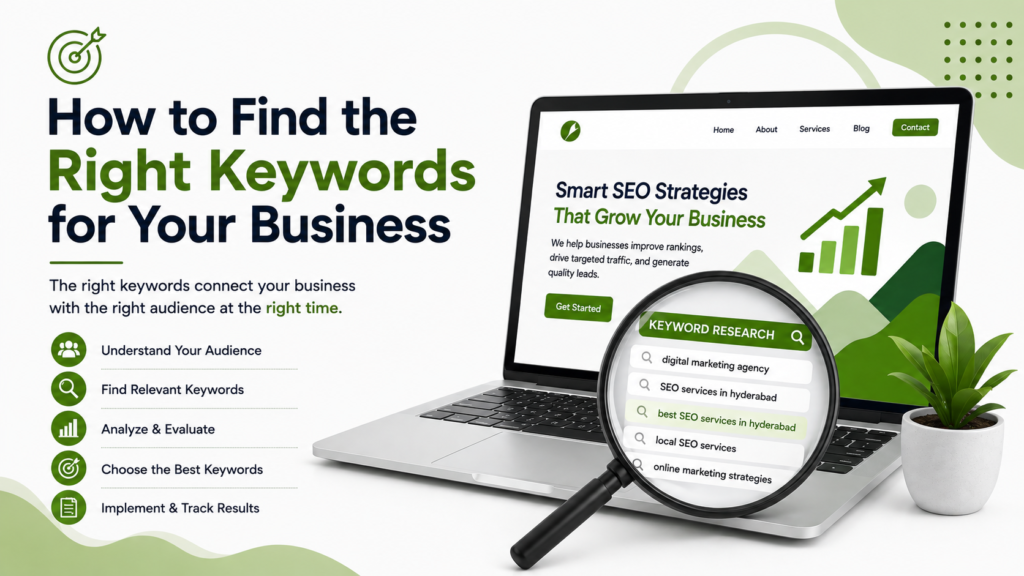
So, picking keywords for SEO isn’t just about chasing high search volumes. You can get a lot of traffic, but if those visitors aren’t actually interested in what you do, it doesn’t help your business.
Actually, the real question is, what are your potential customers typing into Google when they’re looking for something you actually offer? That’s what keyword research should help you figure out.
Once you know that, you can build pages and content that actually match what people are searching for. You can also decide which keywords are worth your time based on how relevant they are, how tough the competition is, what people want when they search, and whether those searches can turn into business.
Whether you’re starting a new website or trying to improve your current SEO, having a clear keyword strategy keeps your content focused and avoids wasted effort.
Start With Your Customers, Products, And Services
Before you even touch a keyword tool, write down what you already know about your business and your customers.
List your:
- Main products or services
- Individual service categories
- Customer problems
- Frequently asked questions
- Locations you serve
- Industries or customer segments
- Common reasons people contact you
For example, if you’re a digital marketing agency, start with basics like SEO, Google Ads, social media marketing, content marketing, website development, and lead generation.
But don’t stop at service names.
Think about how your customers actually describe their problems.
A business owner may not search for “conversion optimization.” They might search for:
- How to get more leads from my website
- Why is my website not generating enquiries?
- How to improve website conversions
- Best digital marketing agency for small businesses
This kind of customer language often shows you keyword ideas that tools alone won’t catch.
Talk To Your Sales And Customer Support Teams
Your current customers are usually your best source for real keyword ideas.
Ask your sales team:
- What questions do prospects ask before purchasing?
- Which services generate the most enquiries?
- What objections appear repeatedly?
- Which terms do customers use to describe their needs?
Review customer emails, enquiry forms, chat conversations, reviews, and sales calls where appropriate.
This way, your keyword list is based on what people actually say, not just what you think they might search for.
Understand Search Intent Before Choosing A Keyword
Search intent refers to the reason behind a search.
Two keywords can look similar but represent completely different stages of the buying journey.
Informational Intent
The user wants to learn something.
Examples:
- What is technical SEO?
- How does Google Ads work?
- How to improve website speed
A detailed blog or guide may be the right content format.
Commercial Intent
The user is researching solutions or providers.
Examples:
- Best SEO agency in Hyderabad
- SEO company reviews
- SEO services for small businesses
Comparison articles, service pages, case studies, and detailed guides can work well here.
Transactional Intent
The user is closer to taking action.
Examples:
- SEO services in Hyderabad
- Hire SEO agency
- SEO consultation
These searches may be better matched with service pages, landing pages, enquiry forms, or consultation CTAs.
Navigational Intent
The user is looking for a particular business, website, or page.
For example:
- SpaceKey Digital
- SpaceKey Digital SEO services
- SpaceKey Digital contact
If you get search intent wrong, you end up trying to rank a blog post for something that actually needs a service page, or you use a sales page when people just want information. That’s a common SEO mistake.
Use Keyword Research To Find Real Opportunities
Once you have your initial list, use keyword research tools to validate it.
Depending on the platform, you may find information such as:
- Estimated search volume
- Keyword variations
- Competition
- Search trends
- Related questions
- Related phrases
- Cost-per-click indicators
These numbers are helpful, but don’t let them decide everything for you.
Just because a keyword has a lot of searches doesn’t mean it’s better than one with less volume.
Imagine two keywords:
Keyword A: 10,000 searches per month, but very broad and poorly aligned with your service.
Keyword B: 500 searches per month, but closely connected to a service with strong buying intent.
Keyword B might actually bring in more business, even with fewer searches.
The point isn’t to chase the biggest numbers. You want searches from people who could actually become your customers.
Focus On Long-Tail And Local Keywords
Broad keywords are usually tough to rank for, especially if your website is new or not a big brand.
Long-tail keywords provide a more specific alternative.
Compare:
“SEO”
with:
“SEO services for healthcare businesses in Hyderabad”
The second phrase is more specific. It might get fewer searches, but you know exactly what the person wants.
Long-tail keywords can be useful for:
- Specific services
- Industry-focused services
- Local searches
- Product variations
- Customer problems
- Highly specific questions
Don’t Ignore Local Search
If your business serves a particular city or region, location-based searches deserve attention.
For example:
- SEO services in Hyderabad
- Digital marketing agency in Hyderabad
- Local SEO company in Hyderabad
- Performance marketing agency in Hyderabad
Adding a location to a keyword can turn a generic search into something much more valuable for your business.
For businesses targeting Hyderabad customers, Best SEO Services in Hyderabad can be an important commercial topic to address through a properly optimized service page and supporting content.
But don’t just swap out ‘Hyderabad’ for every city and make a bunch of thin pages. Each local page should actually help people in that area and explain why you serve them.
Analyze Competitors And The Search Results
Keyword tools are helpful, but you should always check what actually shows up in Google for your target keywords.
Search your target phrases and study what appears on the first page.
Look at:
- The types of websites ranking
- Search intent
- Content formats
- Service pages versus blog posts
- Local businesses
- Featured snippets
- People Also Ask results
- Content depth
- Topics covered by competitors
If the first page is full of detailed guides, a short 500-word service page won’t cut it. You need to match what people expect.
But if you see a lot of local service providers ranking, then a strong local service page is probably the way to go.
The point of competitor research is to spot gaps, not to copy what everyone else is doing.
Ask yourself:
What useful information are the current results missing?
Can I explain the subject more clearly?
Can I provide better examples or practical advice?
Can my business demonstrate real experience or expertise?
That’s when SEO stops being just about keywords and starts being about real business growth.
Build A Keyword Map For Your Website
Once you’ve done your research, don’t try to cram every keyword onto a single page.
Create a keyword map that assigns search terms to appropriate URLs.
For example:
Search Intent | Keyword Example | Recommended Content |
Informational | How does SEO work? | Blog |
Informational | SEO checklist | Guide |
Commercial | Best SEO agency in Hyderabad | Comparison/guide |
Transactional | SEO services Hyderabad | Service page |
Local | SEO company near me | Local/service page |
Problem-based | Why is my website traffic dropping? | Blog |
This way, your website actually makes sense to both users and search engines.
Your main service page can target a commercially important phrase, while supporting blog posts answer related questions and internally link back to the service.
For example, an article about local search optimization can naturally direct interested readers toward your Best SEO Services in Hyderabad page.
This connects your educational content with your main service pages, so people can move from learning to taking action.
Prioritize Keywords Based On Business Value
After building your list, rank the opportunities.
A practical evaluation can consider four factors:
Relevance
Does the keyword directly relate to what you sell?
Intent
Is the person learning, researching, comparing, or ready to take action?
Competition
How difficult will it be to compete against the existing results?
Business Value
If someone finds your page through this search, how valuable could that visitor be?
You can even give each keyword a simple priority score to keep things organized.
For instance:
High priority: Highly relevant + strong commercial intent + realistic competition
Medium priority: Relevant + informational intent + good content opportunity
Low priority: Broad + weak business relevance + highly competitive
This stops your SEO plan from turning into a giant list of keywords that never actually get used.
Create Content Around Topics, Not Just Keywords
One of the biggest mistakes is stuffing the same keyword everywhere in your article just because you want to rank for it.
Good content should just cover the topic in a way that feels natural.
If you’re writing about choosing an SEO agency, for example, you might discuss:
- Technical SEO
- Keyword research
- Local SEO
- Content strategy
- Reporting
- Link building
- Conversion tracking
- Experience
- Pricing considerations
This way, readers get a full picture, and you naturally include related keywords without forcing them in.
The same goes for service pages. Explain what you do, who it’s for, how it works, what people can expect, and why they should trust you.
Measure Performance And Refine Your Strategy
Keyword research isn’t a one-time thing. It doesn’t stop once you hit publish.
Keep an eye on how your key pages perform over time.
Useful metrics include:
- Search impressions
- Organic clicks
- Click-through rate
- Keyword positions
- Organic traffic
- Leads
- Enquiries
- Conversion rate
More importantly, connect SEO metrics to business outcomes.
If a page ranks well but doesn’t bring in any leads, maybe it needs a stronger commercial angle. If a page gets leads from keywords you didn’t expect, that could be a new opportunity to explore.
SEO becomes more effective when you use performance data to make decisions. A few common mistakes can mess up an otherwise solid SEO plan.
Common Keyword Research Mistakes To Avoid
A few mistakes can weaken an otherwise good SEO strategy.
Choosing keywords only because they have high volume: Traffic without relevance has limited value.
Ignoring search intent: The wrong page type may struggle to rank even with excellent optimization.
Targeting only short keywords: Specific searches can provide valuable opportunities.
Copying competitor keywords blindly: Your customers and business model may be different.
Stuffing keywords into content: Excessive repetition makes content difficult to read and doesn’t create a better user experience.
Ignoring local searches: Location-specific businesses can miss highly relevant opportunities.
Never updating keyword research: Customer behavior, competitors, and search trends change over time.
If you want to go after tough commercial keywords, you need a strategy that brings together keyword research, technical SEO, content, local SEO, and tracking results. That’s what we do at SpaceKey Digital.
Final Thoughts
At the end of the day, finding good keywords is really about understanding people and what they’re looking for.
Start with the questions your customers ask. Connect those questions with your products and services. Validate your ideas with keyword research, study search intent, examine competitors, and prioritize opportunities according to business value.
Then map each keyword to the right page and create content that genuinely helps the person searching.
You don’t need thousands of keywords to get started. A focused list of relevant, realistic, and valuable terms is a much better foundation for long-term growth.
If you’re competing in Hyderabad or anywhere else, don’t treat ‘Best SEO Services in Hyderabad’ as just a keyword. Make it part of a bigger plan that connects search visibility, helpful content, strong service pages, local relevance, and real business results.
Ready To Improve Your Search Visibility?
A solid keyword strategy helps you reach people who are already looking for what you offer. If you need help with keyword research, technical SEO, content, or local SEO, just reach out to SpaceKey Digital.
Contact SpaceKey Digital to discuss an SEO strategy built around your business goals.
FAQs
1. What makes a keyword valuable for a business?
A valuable keyword should be relevant to the business, connected to a genuine customer need, and capable of attracting an audience that has potential commercial value. Search volume is useful, but it should not be the only deciding factor.
2. How many keywords should I target on one page?
There is no fixed number. Focus on one primary topic and cover closely related questions and concepts naturally. A single well-developed page can rank for multiple relevant search variations.
3. Are long-tail keywords worth targeting?
Yes. Long-tail phrases are often more specific and can align closely with particular customer needs. They can be especially useful when a business is competing against established websites for broader terms.
4. How can I find keywords my competitors are ranking for?
You can use SEO research tools to identify competitor keywords, then manually review the search results to understand intent and content quality. The goal should be to find opportunities and content gaps rather than reproduce competitor content.
5. Can an SEO agency help with keyword research?
Yes. An experienced SEO team can combine keyword research with competitor analysis, search-intent analysis, technical SEO, content planning, and conversion objectives. For businesses targeting Hyderabad, Best SEO Services in Hyderabad can provide a useful starting point for researching local commercial opportunities.