
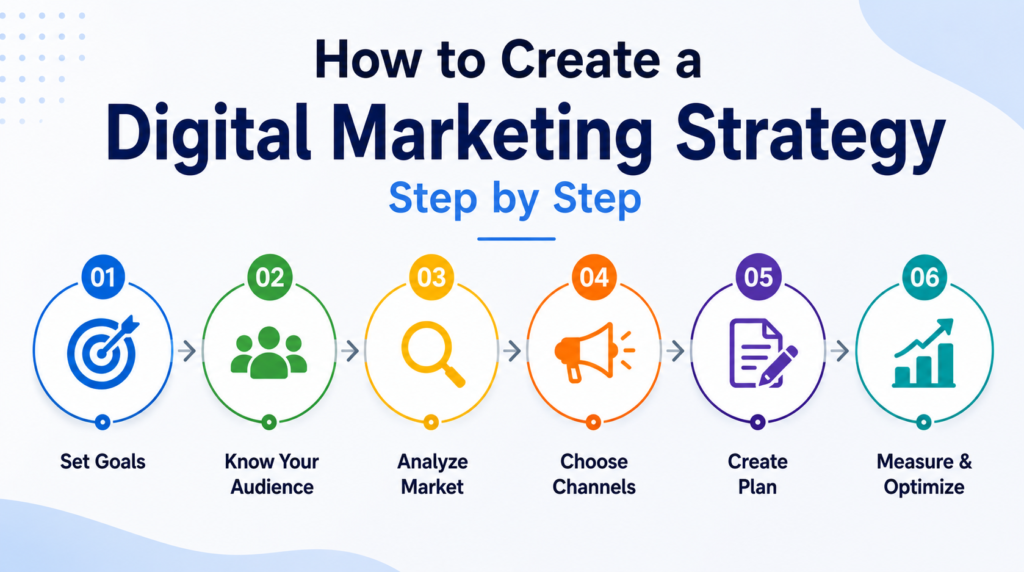
So, digital marketing usually gets complicated when businesses jump into platforms before figuring out what actually matters. Just opening an Instagram account or running Google Ads might keep you busy, but that doesn’t mean you have a real strategy.
A solid strategy always starts with a clear business goal. Then you work backward-figure out who your customers are, which channels make sense, what messages and offers will move the needle, and what actions you actually want people to take.
That’s why building a digital marketing strategy isn’t just about picking what to post or where to run ads. It’s about building a system where every activity has a clear purpose and fits into the bigger picture.
For example, at SpaceKey Digital, we always start with a proper business audit. Then we move to strategy, execution, optimization, and focus on long-term growth.
1. Start With Business Goals And Market Research
Before you pick any marketing channel, get clear on what you actually want to achieve as a business.
Saying you want to ‘increase online visibility’ is a start, but you need to make it measurable.
You might instead define objectives such as
Generate 100 qualified enquiries per month
Increase organic traffic over the next six months
Improve online sales
Increase repeat purchases
Build awareness in a specific city
Reduce the cost of acquiring a customer
Once you know your goal, dig into the market around it.
Understand Your Target Audience
Figure out who’s actually likely to buy from you.
Consider:
Age and location
Industry or profession
Buying behavior
Problems they are trying to solve
Questions they ask before purchasing
Preferred communication channels
Budget and decision-making factors
Reasons they may hesitate
The point isn’t to make up a fake customer profile with random details. Focus on what really influences someone to buy.
Study The Competitive Landscape
Check out your competitors to see how the market is talking right now.
Look at their:
Website positioning
Search visibility
Offers
Content
Social media activity
Reviews
Advertising messages
Calls to action
Customer experience
Don’t just copy what competitors are doing. Look for gaps they’re missing.
Maybe your competitors run strong ads, but their content is weak. Or they’re active on social but their landing pages don’t convert. These gaps are your chance to stand out.
2. Define Your Positioning, Offer, and Customer Journey
Once you get the market, decide how you want to position your business.
A useful positioning statement should answer three questions:
Who do you help?
What problem do you solve?
Why should customers choose you?
This forms the base for your website, ads, social content, sales material, and offers.
Build A Clear Offer
Marketing gets a lot easier when people have a clear reason to take the next step.
Depending on the business, that could be
Free consultation
Product demonstration
Assessment
Trial
Downloadable guide
First-purchase offer
Free quotation
Strategy session
Your offer should match where the customer is in their buying journey.
If someone is just finding your business, they probably won’t buy right away. Give them something useful-like an educational resource or a quick consultation-as a first step.
Map The Customer Journey
Don’t just stop at the first click.
A simple journey could look like this:
Search/Social Media → Website → Service Page → Lead Form → WhatsApp/Email Follow-Up → Sales Conversation → Customer
Every stage should have a clear purpose.
This is where strategy turns practical. You’re connecting all the activities into one customer journey instead of treating them as separate tasks.
3. Choose The Right Digital Marketing Channels
A lot of businesses try to be everywhere at once. That’s a mistake.
It’s better to pick channels based on where your audience actually is, what your business needs, what competitors are doing, your resources, and how people buy in your space.
SEO
SEO can help businesses capture people who are actively searching for relevant information, products, or services.
A strong SEO plan can include:
Keyword research
Technical SEO
Service-page optimization
Local SEO
Content creation
Internal linking
Search-intent analysis
Performance monitoring
If your business relies on people finding you through search, SEO should probably be one of your main long-term channels.
Paid Advertising
Google Ads and social advertising can help businesses reach specific audiences and test offers more quickly.
Paid campaigns should have:
A defined objective
Clear audience targeting
Relevant ad messaging
Dedicated landing pages
Conversion tracking
Budget controls
Ongoing optimization
Paid ads shouldn’t run in isolation. Your ad, landing page, offer, follow-up, and sales team all affect the final result.
Social Media Marketing
Social platforms are good for building visibility, trust, engagement, and demand.
Content can include:
Educational posts
Short-form videos
Customer stories
Product demonstrations
Expert insights
Behind-the-scenes content
FAQs
Industry commentary
The right platform depends on where the target audience actually spends time and how they make decisions.
Content Marketing
Content should answer real customer questions, not just fill up a publishing calendar.
Useful formats include blogs, guides, videos, case studies, landing pages, email content, and social posts.
SpaceKey Digital’s content offering similarly covers website content, blogs, social media posts, video scripts, landing pages, and other SEO-focused content formats.
4. Create A 90-Day Execution Plan
A strategy is only useful if it tells your team exactly what to do next.
One practical approach is to divide execution into three stages.
Days 1–30: Foundation
Focus on understanding and preparation.
Activities may include:
Business audit
Competitor research
Audience research
Keyword research
Website review
Tracking setup
Positioning
Offer development
Content planning
Campaign preparation
This stage reduces the risk of launching campaigns before the basic marketing system is ready.
Days 31–60: Traction
Move from preparation into active execution.
Depending on the business, this could involve:
Launching Google Ads
Publishing SEO content
Starting social campaigns
Testing landing pages
Launching lead magnets
Building remarketing audiences
Beginning email or WhatsApp nurturing
Monitoring lead quality
At this stage, don’t assume your original strategy is perfect. Use early data to spot what needs fixing.
Days 61–90: Optimization And Scaling
By this stage, you should have enough information to identify stronger and weaker activities.
Review:
Lead volume
Lead quality
Conversion rate
Cost per lead
Customer acquisition cost
Organic traffic
Search visibility
Content engagement
Sales performance
Double down on what’s working and keep testing ways to improve the weaker spots.
SpaceKey Digital describes its own 90-day strategy as an operational blueprint and emphasizes ongoing monitoring and optimization across SEO, Google Ads, social media, landing pages, customer behavior, and content engagement.
5. Measure Performance And Improve Continuously
A digital marketing strategy is never really finished.
The market changes. Customer behavior changes. Competitors introduce new offers. Advertising costs fluctuate. Search results evolve. Your own business priorities may also change.
So, tracking your results is essential.
Choose KPIs That Match Your Goal
If your objective is awareness, useful measurements may include:
Reach
Impressions
Branded searches
Video views
Website traffic
For lead generation, focus on:
Qualified leads
Conversion rate
Cost per qualified lead
Sales opportunities
Customer acquisition cost
For e-commerce, you may track:
Revenue
Conversion rate
Average order value
Customer acquisition cost
Repeat purchases
Return on advertising spend
Don’t judge a campaign by metrics that don’t tie back to your business goal.
For example, thousands of social media impressions may look impressive, but they do not necessarily indicate that a campaign is generating qualified customers.
Use Data To Make The Next Decision
A useful optimization cycle is:
Plan → Launch → Measure → Learn → Improve → Scale
This way, you make decisions based on real data, not guesses.
A case study from SpaceKey Digital illustrates this type of structured approach for a B2B business, combining technical SEO, product-focused content, social media, and Google Business Profile optimization around specific search demand and business objectives.
10 Supporting Elements That Strengthen A Digital Marketing Strategy
A complete strategy should cover these ten areas:
Business objectives – What result are you trying to achieve?
Market research – What is happening in your category?
Audience research – Who is most likely to buy?
Competitor analysis – Where are competitors strong or weak?
Brand positioning – Why should customers choose you?
Offer strategy – What motivates the next action?
Channel selection – Where should you invest your resources?
Sales funnel – How does a visitor become a customer?
Measurement – Which KPIs indicate progress?
Optimization – What will you change based on performance?
These parts work best when they’re connected, not managed as separate activities.
For businesses that need a broader view, SpaceKey Digital digital marketing services cover areas including SEO, performance marketing, social media, content marketing, automation, branding, and customer nurturing.
Common Mistakes To Avoid
Even the best strategy can fail if you don’t execute consistently.
Avoid these common problems:
Choosing channels without research: Don’t advertise on a platform simply because competitors are using it.
Focusing only on traffic: Traffic is nice, but qualified leads and conversions matter more for your business.
Changing direction too quickly: Some channels-especially SEO and content-take time to show real results.
Ignoring the sales process: Marketing can generate leads, but poor follow-up can prevent those leads from becoming customers.
Failing to track conversions: If you don’t track properly, you won’t know what’s actually driving business results.
Treating strategy as a one-time document: Your strategy should keep evolving as you get new data and the market shifts.
Final Thoughts
How to Create a Digital Marketing Strategy Step by Step is ultimately about creating a logical connection between business goals and customer actions.
Start with your business. Get the market. Know your audience. Study your competitors. Define your positioning and offer. Pick the channels that actually make sense. Map out the customer journey. Build a 90-day execution plan. Then track what happens and keep improving based on real data.
Digital marketing works best when SEO, content, ads, social, your website, lead generation, and nurturing all push toward the same goal instead of running as separate activities.
If you want to explore the broader strategy and execution approach, SpaceKey Digital’s digital marketing page provides an overview of its strategy, services, and growth-focused workflow.
Ready To Build Your Digital Marketing Strategy?
If your marketing feels all over the place or you’re not sure which channels are worth your time and money, it’s probably time to get a proper strategy in place.
Contact us for a strategy discussion and start building a digital marketing roadmap aligned with your business goals, audience, and growth priorities.
FAQs
1. What should I do before creating a marketing plan?
Start by defining your business objectives, understanding your target audience, researching competitors, and reviewing your current digital presence.
2. How do I choose the right marketing channels?
Choose channels based on where your target customers spend time, how they search for solutions, your business goals, available budget, and the length of your sales cycle.
3. How long should a marketing strategy cover?
A 90-day execution period is a practical starting point. It provides enough time to launch activities, collect performance data, identify opportunities, and make informed adjustments.
4. Which metrics should I track?
The right metrics depend on your objective. Common measurements include qualified leads, conversion rate, website traffic, customer acquisition cost, revenue, engagement, and return on advertising spend.
5. Why is continuous optimization important?
Market conditions, customer behaviour, competitors, and campaign performance can change over time. Regularly reviewing results helps you improve underperforming activities and invest more effectively in strategies that are delivering useful outcomes.