
A business goal only matters if you can break it down into clear actions, assign them to the right people, set real deadlines, and actually measure what happens.
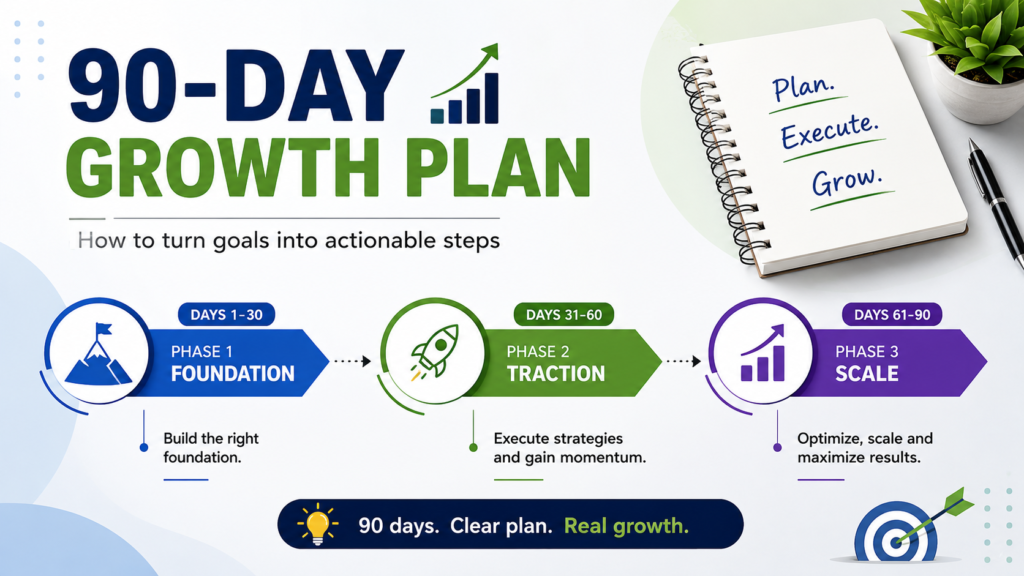
A 90-day growth plan helps you do exactly that. Instead of trying to fix everything at once, you get a focused three-month roadmap with three stages: Foundation, Traction, and Scale.
This approach works for any industry – healthcare, education, services, startups, or local businesses. The main thing is to tie every activity back to a real business goal.
If you want a roadmap that actually fits your business, just tell us where you are right now. We’ll map out what Foundation, Traction, and Scale should look like for you.
Why A 90-Day Growth Plan Works
1. Start With A Clear Business Objective
The first step is to determine what the business actually wants to achieve.
Goals like ‘increase visibility’ or ‘get more engagement’ are fine to start with, but you need to turn them into something you can actually measure.
For example, a business may want to:
- Generate qualified enquiries
- Increase consultation bookings
- Improve local search visibility
- Build a stronger referral network
- Increase website traffic
- Generate more sales opportunities
Once you know your main goal, it’s much easier to decide which marketing activities actually matter.
The 90-day strategy developed for Progenics, for example, focused on patient acquisition, local visibility, specialist consultations, and building a doctor referral pipeline rather than simply increasing social media activity.
2. Identify Your Audience And Market Opportunity
Before you spend time or money on campaigns, figure out where the real demand is.
Do some audience research to find out who actually needs your product or service, and what makes them take action.
The Progenics roadmap identified several distinct audiences, including parents of children with ASD, families dealing with genetic or rare diseases, women interested in HPV testing, patients taking multiple medications, IT professionals interested in preventive genomics, and doctors who could become referral partners.
This applies to any business. Know who you want to reach before you figure out how to reach them.
Turn Strategy Into A 90-Day Execution Plan
3. Days 1–30: Build The Foundation
The first month is all about setting up the basics you need to grow later.
Typical activities may include:
- Market and competitor research
- Website improvements
- SEO foundations
- Google Business Profile optimization
- Conversion tracking
- Offer development
- Content planning
- Lead-generation funnel setup
In the Progenics plan, the foundation included Google Business Profile optimization, local SEO, website improvements, micro-offers, content planning, and video production.
This stage matters because your campaigns won’t work if people can’t find your business or don’t get what you offer.
4. Create Offers That Encourage Action
Not every potential customer is ready to make a major purchase immediately.
A good growth strategy gets people to make small commitments first, before you ask for a bigger decision.
The Progenics strategy used a ladder of commitment that included entry-level offers such as a Gut Quiz and Family Genetic Risk Screening, followed by specialist consultations and higher-value services.
A simple structure is:
Free → Engagement → Consultation → Service
The goal is to make the next step easy and relevant, not just push everyone to buy right away.
5. Days 31–60: Generate Traction
Once the fouOnce you’ve got the basics in place, month two is about actually generating demand.on the business, this could include:
- Google Ads
- SEO content
- Social media campaigns
- Lead-generation campaigns
- Retargeting
- Email nurturing
- Referral outreach
For Progenics, this stage included Google Ads around relevant services and locations, continued social content, patient-focused videos, and doctor outreach.
The key here is simple: paid traffic should go somewhere useful. Don’t just send people to your homepage. Connect your campaigns to landing pages with a clear next step.
6. Days 61–90: Scale What Is Working
The third month is where performance data becomes especially valuable.
Don’t just spend more because you see clicks. Look at what’s actually bringing in leads or sales.
Review:
- Audience performance
- Lead quality
- Offers
- Keywords
- Content
- Landing pages
- Conversion rates
- Campaign costs
The Progenics roadmap used month three to focus on scaling successful activities and improving local visibility, referral activity, and digital demand generation.
The rule is simple:
Don’t scale activity. Scale what works.
Connect Every Marketing Channel
7. Build One Customer Journey
SEO, social media, paid advertising, content, and referrals should not operate as completely separate activities.
They should work together as one customer journey.
For example:
Google Search → Landing Page → Qualification → Specialist Consultation → Service
Another journey might look like this:
Instagram Reel → Micro-Offer → Consultation → Conversion
The Progenics plan specifically used connected journeys like these to move prospects from initial awareness toward consultation and conversion.
This structure also makes it easier to identify where potential customers are dropping out.
8. Build Trust Through Useful Content
Content should help people move through the buying journey, not just fill up your social calendar.
For complex services, educational content can be especially valuable.
The Progenics content strategy was organized around three pillars:
- Clarity
- Prevention
- Science Trust
It also recommended two expert-facing content personalities: a genetic counselor focused on patient communication and a laboratory scientist focused on explaining the science behind testing.
For other businesses, the topics will change, but the idea is the same. Use content to answer real questions and build trust.
A Simple 90-Day Growth Roadmap
Period | Primary Focus | Key Activities |
Days 1–30 | Foundation | Research, positioning, website, SEO, offers, tracking |
Days 31–60 | Traction | Ads, content, lead generation, retargeting, outreach |
Days 61–90 | Scale | Optimization, stronger campaigns, referrals, expansion |
This framework is flexible. You can adapt it to any business.
For example, the Progenics plan focused on healthcare-specific activities such as specialist consultations, patient education, WhatsApp funnels, and doctor referrals. A school could instead prioritize local SEO, Google Maps, admission landing pages, Meta Ads, Google Ads, campus visits, and parent-focused content.
The framework doesn’t change, but your actions should fit your business.
If you want to see how this would look for your business, just tell us where you are right now. We’ll help turn your goals into a focused 90-day plan with clear activities and milestones.
Start Your 90-Day Growth Plan →
Final Thoughts
A 90-day growth plan is useful because it turns big goals into a practical set of steps you can actually execute.
The process is straightforward:
Set the goal → Understand the audience → Build the foundation → Launch focused activities → Measure results → Optimize → Scale
The point isn’t to predict everything that’ll happen in three months. It’s to give you enough structure to move fast, learn from real results, and make better decisions.
The Progenics strategy demonstrates how market research, SEO, paid advertising, social content, expert positioning, micro-offers, and referral development can be integrated into a structured 90-day roadmap.
Not sure what Foundation, Traction, and Scale should look like for your business? Map out your own 90-day plan based on your goals, audience, and where you are right now—just like we did for Progenics.
Ready To Build Your 90-Day Growth Plan?
If you have business goals but no clear plan to execute, SpaceKey Digital can help you turn those goals into focused actions and a real growth roadmap.
Reach out to SpaceKey Digital and let’s build your next 90-day growth plan.