
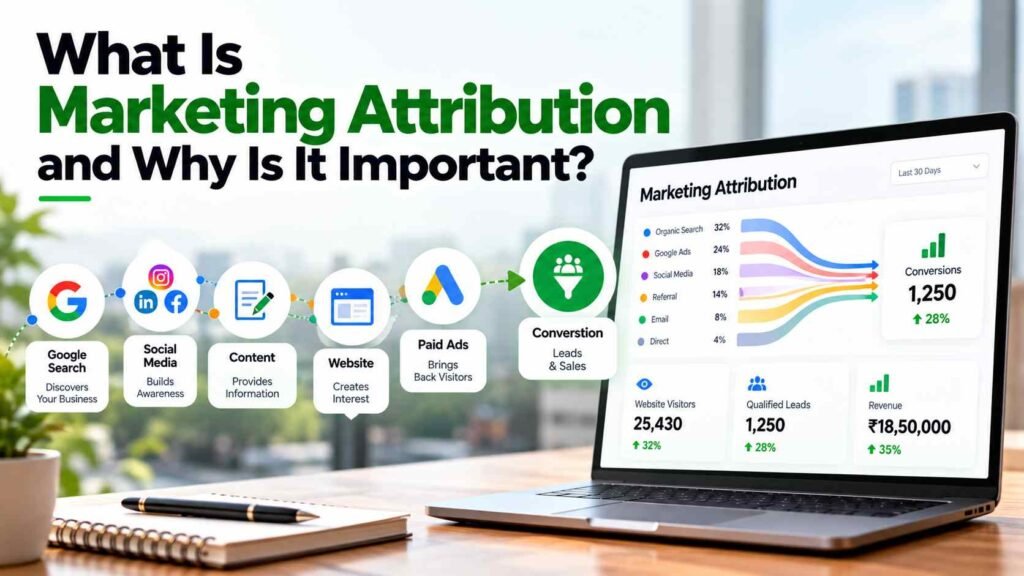
Marketing attribution is basically figuring out which channels, campaigns, or touchpoints actually help you get a conversion. It’s not just about the last click or the final enquiry. You want to see the whole journey-from the first time someone hears about you to when they finally buy, sign up, or reach out.
A customer rarely converts after seeing one advertisement. They might discover a business through Google, read a blog, watch a social media video, click a remarketing ad, and finally submit a form after visiting the website several times.
Attribution connects all these steps, so you can see which touchpoints actually move people closer to taking action.
1. First-Touch Attribution
First-touch attribution gives credit to the first marketing interaction that introduced a customer to the business.
For example, someone may discover a company through an organic Google search and later return through a paid advertisement before submitting an enquiry. In a first-touch model, the initial organic search receives the credit.
This model is useful if you mainly want to know which channels are bringing in new people at the start.
2. Last-Touch Attribution
Last-touch attribution assigns credit to the final marketing interaction before conversion.
Suppose a customer discovers your company through Instagram, reads several blog posts, and eventually clicks a Google Ads campaign before contacting your sales team. The final paid search interaction receives the attribution.
It’s easy to use, but you might miss out on what actually influenced the customer before that last step.
3. Multi-Touch Attribution
Multi-touch attribution considers multiple interactions throughout the customer journey.
This approach is particularly useful for businesses with longer buying cycles. A B2B customer, for instance, may interact with a website, download a resource, speak with a salesperson, revisit a product page, and then request a proposal.
Instead of giving all the credit to one step, multi-touch models spread it out across the different touchpoints that actually mattered.
Why Is Marketing Attribution Important For Business Growth?
Actually, attribution isn’t just about tracking numbers. It’s about connecting your marketing work to real business results and seeing where your spend is actually making a difference in the customer journey.
If you want to know why attribution matters, just look at how it helps you decide where to put your budget, which campaigns to double down on, and how to fix your conversion paths.
4. Better Marketing Budget Allocation
Most businesses spend on SEO, Google Ads, social media, email, and content. But if you don’t use attribution, you’re probably making budget decisions based on surface metrics like clicks or impressions-which don’t always tell the full story.
Attribution gives you the extra context you need.
For example, paid search might bring in direct conversions, while your organic content helps people along the way before they convert. Both matter, just in different ways. Knowing this helps you spend smarter.
5. Understanding The Customer Journey
Customers rarely take a straight path.
A typical journey might look like this:
Google Search → Blog Article → Social Media → Website Visit → Remarketing Ad → Enquiry
Each interaction can influence the next step.
Attribution lets you look at the whole journey, not just each channel by itself.
6. Measuring Campaign Performance
Don’t judge a campaign just by traffic or engagement.
If a campaign gets thousands of clicks but barely any good leads, you need a different approach than a smaller campaign that’s actually bringing in quality enquiries.
Attribution connects marketing touchpoints with outcomes such as:
- Leads
- Sales
- Enquiries
- Signups
- Purchases
- Revenue
- Assisted conversions
This way, your campaign analysis actually means something for your business.
Which Marketing Attribution Models Should Businesses Use?
There’s no one-size-fits-all attribution model. What works best depends on your sales cycle, how many touchpoints you have, what data you can track, and your actual conversion goals.
7. Linear Attribution
Linear attribution distributes credit relatively evenly across the identified touchpoints.
For example, if a customer interacted with four marketing channels before converting, each interaction could receive an equal share of the attribution.
It’s simple and gives you a bigger picture of the journey, but it assumes every touchpoint mattered the same-which isn’t always true.
8. Time-Decay Attribution
Time-decay attribution gives greater weight to interactions that happened closer to the conversion.
If your customers usually decide based on recent interactions, this model gives you better context.
But don’t forget-the first touchpoint might still be what got them interested in the first place.
9. Position-Based Attribution
Position-based attribution gives more weight to selected points in the customer journey, commonly the first and last interactions.
This helps you see both where you first got the customer and what finally made them convert, while still giving some credit to the steps in between.
10. Data-Driven Attribution
Data-driven attribution uses available conversion data to determine how different interactions contribute to outcomes.
You get a more detailed view than with fixed rules, but your results are only as good as your data.
For smaller businesses, a simpler model with reliable tracking can often be more practical than adopting a complex attribution system without sufficient data.
How Can Businesses Improve Attribution Accuracy?
So, good attribution starts with solid measurement. Even the best model can’t fix bad tracking, messy campaign names, or disconnected platforms.
Tracking Website Conversions
First, be clear about what actually counts as a conversion for your business.
Depending on the business model, this could include:
- Contact form submissions
- Phone calls
- WhatsApp enquiries
- Product purchases
- Appointment bookings
- Brochure downloads
- Demo requests
Focus your tracking on real business actions, not just vanity metrics.
Connecting Marketing Platforms
Attribution only works well if you can actually connect data from all your channels.
A business may use Google Analytics, Google Ads, Meta Ads, CRM software, email marketing platforms, and call-tracking systems. If these systems operate independently, it becomes difficult to understand the complete customer journey.
Keep your tracking parameters and campaign names consistent. It makes cross-channel analysis much easier.
Using UTM Parameters
UTM parameters show you exactly where your website traffic is coming from.
For example, campaigns can be tagged according to:
- Source
- Medium
- Campaign
- Content
- Keyword or promotion
If you use consistent UTM names, it’s much easier to see which campaigns and sources are working inside your analytics.
Connecting Marketing With CRM Data
If you’re focused on lead generation, don’t stop at the website form. Track what happens next.
A CRM can help connect marketing-generated enquiries with later sales stages, such as:
Lead → Qualified Lead → Consultation → Proposal → Customer
This way, you actually know which leads turn into real revenue.
How Should You Use Attribution To Improve Your Digital Strategy?
Don’t let attribution turn into another dashboard nobody looks at. The real value is using customer journey data to make better decisions.
A marketing team can use attribution insights to ask questions such as:
- Which channels introduce the most new prospects?
- Which campaigns generate qualified leads?
- Which channels assist conversions?
- Where do potential customers drop out?
- Which landing pages support conversions?
- Which campaigns generate revenue rather than just traffic?
- Does organic search influence customers before paid campaigns convert them?
For example, you might find that SEO brings in a lot of early traffic, Google Ads gets people who are ready to buy, social media builds awareness, and remarketing brings back people who left. That’s what attribution does-it helps you see these relationships instead of treating every channel the same. This is especially useful when you’re planning your overall digital strategy. If you want to connect SEO, paid ads, content, social, and conversions, check out Best Digital Marketing Services in Hyderabad for a more integrated approach.
If you’re focused on organic growth, take a look at Best SEO Services in Hyderabad to see how SEO fits into your bigger acquisition plan.
What Are The Common Marketing Attribution Mistakes?
Attribution can be misleading if you treat the numbers as gospel instead of using them as evidence to make better decisions.
Common mistakes include:
- Relying entirely on last-click attribution
- Ignoring offline interactions
- Using inconsistent UTM parameters
- Failing to track phone or WhatsApp enquiries
- Measuring clicks instead of qualified conversions
- Treating every channel as equally valuable
- Changing attribution models without documenting the change
- Ignoring longer customer journeys
- Using incomplete CRM information
- Assuming attribution proves causation
It is also important to remember that attribution models are measurement frameworks. They do not perfectly capture every influence on a customer’s decision.
A customer may see a billboard, hear a recommendation from a colleague, search the brand on Google, and later click an advertisement. Only some of those interactions may be digitally measurable.
For that reason, experienced marketers use attribution alongside other evidence, including customer research, CRM data, sales feedback, conversion data, and campaign performance.
Attribution gives you a structured way to measure your marketing, but don’t forget-real customer behavior is always more complicated than any report.
Want to actually measure what your marketing is doing?
Attribution matters most when it links your marketing to real business results. If you’re tracking SEO, paid ads, social, content, and website data separately, it’s time to connect the dots. You’ll get way more useful insights.
Contact SpaceKey Digital to discuss a digital marketing strategy built around measurable growth and meaningful customer journeys.
FAQs
1. What Is Marketing Attribution And Why Is It Important For Small Businesses?
For small businesses, attribution helps you see which marketing activities actually drive enquiries, sales, and new customers. That way, you can spend smarter and optimize your campaigns.
2. What Is Marketing Attribution And Why Is It Important For SEO?
In SEO, attribution shows you if organic search is bringing in new customers, helping with conversions, or just playing a part before people convert somewhere else.
3. What Is Marketing Attribution And Why Is It Important For Google Ads?
For Google Ads, attribution helps you see if paid search is getting direct conversions or just playing a role in longer customer journeys.
4. What Is Marketing Attribution And Why Is It Important For B2B Marketing?
What Is Marketing Attribution and Why Is It Important? B2B companies often have multiple decision-makers and longer sales cycles, making it useful to connect marketing interactions with qualified leads and later sales stages.
5. What Is Marketing Attribution And Why Is It Important For Digital Marketing?
Attribution helps your digital marketing team see which touchpoints matter across channels, so you can use real data to improve your campaigns, content, landing pages, and budget.