
Here’s the problem I see all the time: teams keep publishing articles, social posts, videos, and emails as separate tasks. Even if you’re posting regularly, it’s easy to lose track of the bigger picture. You end up with content that doesn’t build authority, isn’t consistent, and doesn’t really support your business goals.
Content pillars fix this. Instead of random posts, you pick a central topic and build everything around it. That way, your content actually connects and covers what your audience cares about.
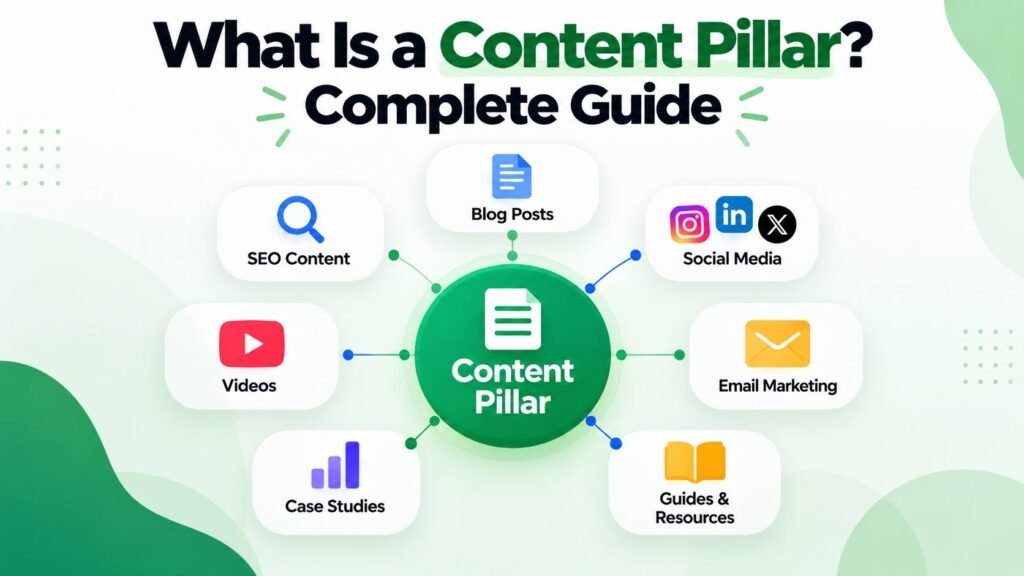
One strong pillar can support blog articles, social posts, videos, emails, guides, FAQs-pretty much any format. The real benefit is that it gives your team a repeatable system for planning and publishing content.
What Is A Content Pillar And How Does It Work?
What is a Content Pillar? Complete Guide discussions usually begin with one simple concept: a content pillar is a broad, strategically important topic that becomes the foundation for multiple related pieces of content.
For example, a digital marketing company might choose SEO as one of its core content pillars. Instead of publishing only general SEO articles, the company could create supporting content around:
- Keyword research
- Technical SEO
- Local SEO
- On-page optimization
- Link building
- Google Business Profile optimization
- SEO reporting
- Search intent
- Website performance
- SEO mistakes
The main topic becomes the pillar, while the narrower subjects become supporting content.
Content Pillar vs. Individual Content Piece
These two concepts are related but different.
A content pillar represents the larger subject or theme your brand wants to consistently discuss.
An individual content piece is one asset created around a specific question, problem, or subtopic.
For example:
Content Pillar: Digital Marketing
Supporting Content:
- How SEO Helps Small Businesses
- Google Ads vs. Organic Search
- Social Media Content Ideas
- Landing Page Optimization
- How To Generate Qualified Leads
This approach makes content planning a lot more intentional and less random.
Why Content Pillars Matter
Without a clear structure, businesses often jump between unrelated subjects. One week might focus on SEO, the next on branding, followed by a random promotional post.
Content pillars are what actually create consistency.
They help teams decide:
- What topics to cover
- Which audiences to target
- What expertise to demonstrate
- Which formats to create
- How content should support business objectives
- Where internal links should lead
A good pillar structure also helps you spot content gaps and avoid repeating the same topics over and over.
How Do You Choose The Right Content Pillars?
Don’t just pick whatever topic is trending. The best pillars are where your audience’s interests, your business expertise, search demand, and what actually drives revenue all overlap.
1. Start With Your Business Expertise
Look at the products or services your business genuinely understands.
An SEO agency might build pillars around SEO, content marketing, local search, paid advertising, and conversion optimization.
A healthcare organization would need a completely different structure based on its services, patient questions, educational needs, and professional expertise.
The goal is simple: build authority in areas where your business actually has something valuable to say.
2. Study Your Audience’s Questions
Your customers already provide clues about what your content should cover.
Review:
- Sales questions
- Customer support conversations
- Search queries
- Website search data
- Social media comments
- Frequently asked questions
- Competitor content
- Product or service objections
If customers keep asking the same question, that’s usually a sign you need a content cluster around that topic.
3. Research Search Intent
Don’t pick your pillars just because a keyword has high search volume.
Consider what users are actually trying to accomplish.
Someone searching “what is technical SEO” is looking for education. Someone searching “SEO agency in Hyderabad” may be comparing providers.
Both searches relate to SEO, but their intent is different.
If you understand these differences, you can create content for every stage-awareness, consideration, and conversion.
Businesses that want to strengthen their broader search strategy can also explore Best SEO Services in Hyderabad.
4. Connect Topics To Business Goals
A pillar needs to do more than just bring in traffic.
Ask:
- Does this topic attract our target audience?
- Does it demonstrate our expertise?
- Can it generate relevant search traffic?
- Can it support our products or services?
- Can it create opportunities for lead generation?
- Can it strengthen brand authority?
If your answers line up, that pillar is actually a strategic asset-not just another blog category.
How Do Content Pillars Improve SEO And Content Marketing?
A solid pillar structure makes your website easier to organize and helps people find what they’re looking for.
Search engines also prefer clearly structured content. Connected pages give them context about what your site covers. But just pumping out lots of pages on the same keyword won’t help. Every page needs a clear purpose and real value.
Building Topic Clusters
A content pillar often works as the center of a topic cluster.
For example:
Pillar: Local SEO
Supporting Articles:
- How To Optimize A Google Business Profile
- Local SEO Citations Explained
- How Reviews Influence Local Search
- Local Keyword Research Guide
- Local Landing Page Best Practices
You should connect these pages with relevant internal links.
That way, visitors can move naturally from a broad topic to more detailed info.
Creating Content Depth
One article rarely answers every question a potential customer has.
A pillar strategy lets you cover a topic from different useful angles.
For example, a business publishing about digital marketing could cover:
- Strategy
- SEO
- PPC
- Social media
- Content
- Email marketing
- Analytics
- Lead generation
- Conversion optimization
- Marketing automation
Instead of writing one giant article that tries to cover everything, you give each subject focused attention.
For businesses looking to connect these areas into one strategy, Best Digital Marketing Services in Hyderabad can provide a useful reference for broader digital marketing planning.
Supporting Internal Linking
Planning internal links gets a lot easier when your content has a clear structure.
A broad pillar page can link to detailed supporting articles, while supporting articles can link back to the pillar when relevant.
This builds a logical content network.
For example:
Digital Marketing → SEO → Technical SEO → Website Speed
Each level answers a more specific question while remaining connected to the larger subject.
How Can You Build A Content Pillar Strategy?
Actually, creating pillars is just step one. The real value comes when you turn that framework into a consistent publishing system.
A practical process can look like this:
Step 1: Define Your Core Topics
Pick three to five broad topics that actually matter to your audience and your business.
Don’t try to do too much. If you’re a small business, you’ll get better results by focusing on three strong pillars instead of spreading yourself thin across fifteen.
Step 2: Create Supporting Topic Ideas
For each pillar, identify specific questions and subtopics.
You can organize them by:
- Beginner questions
- Advanced questions
- Comparisons
- How-to guides
- Common mistakes
- Case studies
- Industry applications
- Tools and resources
- FAQs
- Product or service-related questions
This gives you a practical content inventory you can actually use.
Step 3: Assign Different Content Formats
Not every idea needs to become a blog article.
One topic could become:
- Blog post
- Instagram carousel
- LinkedIn post
- Short-form video
- YouTube video
- Email newsletter
- Infographic
- Case study
- Downloadable guide
This is where content pillars really help social media and content teams stay organized.
One strong topic can be turned into multiple formats without just repeating yourself.
Step 4: Build A Publishing Calendar
Organize topics according to business priorities and audience needs.
A simple monthly calendar might include:
Week 1: Educational pillar article
Week 2: Supporting social content
Week 3: Expert video
Week 4: Case study or conversion-focused content
The exact schedule is up to you. What matters is staying consistent and making sure every piece is relevant to your strategy.
Step 5: Measure And Refine
Don’t just track page views.
Useful indicators include:
- Organic traffic
- Search impressions
- Rankings
- Engagement
- Time spent on content
- Leads
- Assisted conversions
- Email signups
- Social interactions
- Returning visitors
Let your content performance guide what you do next.
If a particular subject consistently attracts relevant visitors and generates enquiries, it may deserve deeper coverage. If another topic receives traffic but no meaningful engagement, review its intent and relevance before producing more similar content.
What is a Content Pillar? Complete Guide content should ultimately help marketers move from random publishing toward a structured system where every major topic has a purpose.
Common Mistakes To Avoid
Content pillar strategies can fail when businesses focus more on quantity than usefulness.
Some common mistakes include:
- Choosing pillars based only on keyword volume
- Creating overly broad topics
- Publishing repetitive supporting articles
- Ignoring search intent
- Failing to connect related pages
- Writing content without a defined audience
- Making every post promotional
- Neglecting older content
- Measuring traffic without business outcomes
- Choosing more pillars than the team can realistically maintain
The best content strategy is not necessarily the one with the largest number of articles. It is the one that consistently provides useful information to the right audience while supporting broader business objectives.
Ready To Build A More Strategic Content System?
Content actually works when every article, post, video, and campaign has a clear job. A solid pillar strategy helps you stay consistent, build authority, support SEO, and stop wasting time chasing random ideas.
Contact SpaceKey Digital to discuss a content marketing strategy designed around your audience, business goals, and long-term digital growth.
FAQs
1. What Is A Content Pillar, And Why Is It Important?
What is a Content Pillar? Complete Guide content shows that a pillar provides a central topic around which related articles, videos, social posts, and other assets can be organized. It helps businesses maintain consistency and build deeper topical coverage.
2. What Is A Content Pillar In SEO?
What is a Content Pillar? Complete Guide approaches SEO content as a connected structure where a broad topic can link to more specific supporting pages. This can improve content organization and help users discover relevant information.
3. What Is A Content Pillar In Social Media Marketing?
What is a Content Pillar? Complete Guide for social media means using recurring themes to guide what a brand publishes. Common themes might include education, industry insights, customer stories, behind-the-scenes content, and product or service information.
4. How Many Content Pillars Should A Business Have?
What is a Content Pillar? Complete Guide does not prescribe one universal number because the right number depends on the business, audience, resources, and content goals. For many smaller teams, starting with three to five focused pillars can make planning easier.
5. Can Content Pillars Help With Content Planning?
What is a Content Pillar? Complete Guide can help transform content planning into a repeatable process. Each pillar can generate supporting topics, formats, campaigns, and publishing ideas while keeping content aligned with broader business objectives.