
You’ve got maybe ₹20,000 left in this month’s marketing budget, and four people telling you four different things to do with it. Run Instagram ads. No, Google. Your cousin who “does digital marketing” says just post more.
None of them have seen your numbers. None of them know your customer’s buying cycle.
That’s the actual problem: there’s no shortage of digital marketing information out there, just a shortage of anyone telling you what to do first without unlimited budget, time, or a marketing degree.
We wrote this because we kept having the same first conversation with new clients: they’d already spent money on the wrong channel before calling us, not because the channel was bad, but because nobody had asked what their business actually needed first.
A starting split for steady search demand. Your actual split depends on the two-question framework below.
This guide is that conversation, written down.
What is digital marketing for a small business?
In short: Digital marketing for a small business means using online channels, search, social, email, paid ads, content, to reach people already looking for what you sell and to stay visible to the ones who aren’t ready yet. Most small businesses only need two or three channels working well, not all of them at once.
That’s the whole definition, not a department, not a dozen platforms running at once. The businesses that struggle are almost always the ones spread too thin, not the ones with too small a budget.
Why it matters
In short: Small businesses that delay digital marketing lose customers who are searching for them right now, not eventually. Close to 28% of local searches convert to a purchase within 24 hours, and the SBA benchmark for marketing spend sits around 7 to 8% of revenue for established businesses.
That 7 to 8% SBA benchmark, per 2026 small business marketing spend benchmarks from Crestmont Capital, assumes healthy profit margins of 10 to 12%. Newer businesses, still building recognition, often need 12 to 20% just to get noticed.
Speed matters more than most owners expect, too. Close to 28% of local searches, the kind where someone types “electrician near me” or “pediatric dentist in Hyderabad”, convert to an actual purchase within 24 hours, per WordStream’s tracking data, as compiled by HubSpot alongside other local search behavior. That’s someone deciding today, not nurturing over months.
If you’re not visible in that moment, someone else is closing that sale. Not because they’re better. Because they showed up first.
That’s the real cost of “we’ll get to marketing eventually”: today’s customer, going to today’s competitor. It also compounds: three consistent years of visibility builds reviews, rankings, and referral habits a competitor can’t buy past in a single quarter.
Common Mistake: Waiting for the “right time” to start marketing. There isn’t one, owners who wait for a bigger budget or a slower season usually just keep waiting, while competitors with a mediocre but consistent presence pull ahead.
Where should you start? A simple decision framework
In short: Don’t pick a channel because it’s trending. Pick it based on two questions: how fast you need revenue, and whether your customer is actively searching for you or needs to discover you first. That decision, not the channel list, is what actually determines where to start.
Most guides at this point hand you a list: SEO, PPC, social, email, content, pick your favorite. That’s not a framework. That’s a menu with no waiter.
Here’s the two-question version we actually walk through with clients before touching a single ad account:
- How long can you wait for a result?
- How much of your customer’s decision happens through search versus discovery?
Need revenue in 30 to 60 days and your customer already searches for you? Start with Google Business Profile and paid search, SEO still matters, but it’s a 3 to 6 month build, not a rescue plan. Customer doesn’t know they need you yet? Start with social and content instead, running paid search on a product nobody’s searching for is just an expensive way to learn that.
Here’s what that looks like in practice. A neighborhood bakery with a slow Tuesday and a wedding order pipeline to fill this month has a short sales cycle and high search intent, someone typing “custom cake near me” tonight. Google Business Profile and local paid search first, SEO second.
A B2B software company selling a tool nobody’s heard of yet has a long sales cycle and near-zero search intent at launch. Content and LinkedIn first, paid search much later, once demand actually exists to capture.
Pro Tip: Most owners chase whatever channel their competitor is visibly running. Wrong logic, visibility doesn’t mean profitability, plenty of businesses run ads that quietly lose money without knowing it. Match the channel to your sales cycle and budget first.
Quick gut check before you pick a channel:
[ ] Can you name your average sales cycle length in days?
[ ] Do you know if your customer searches for businesses like yours, or discovers them?
[ ] Have you got at least 3 months of budget set aside, not just 3 weeks?
[ ] Is there one channel you could fund properly, instead of five you’d fund weakly?
[ ] Do you have a way to track a lead from click to actual outcome?
That’s the real sequencing question: not “which channel is best,” but “which channel fits how fast I need money and how my customer already behaves.”
The core channels, briefly
SEO compounds but takes 3 to 6 months. Paid search and social ads work in days but stop the moment you stop paying. Social media builds trust before someone’s ready to buy. Email is the cheapest channel to run. Content feeds all of the above.
Once you know where to start, here’s what each channel actually does, without the full manual. For the complete range of what we run, see our services overview.
SEO gets you found by people actively searching, and it compounds over time, month twelve usually outperforming month one by a wide margin. It’s slow at the start, roughly 3 to 6 months before real movement, but it’s the closest thing digital marketing has to owned real estate.
PPC, paid search and social ads, buys you speed, you’re in front of buyers within days of launching. The catch: traffic stops the moment you stop paying, and a weak offer gets exposed within days instead of never.
Social media builds recognition and trust before someone’s ready to buy, especially for products people don’t actively search for yet, and it rewards consistency over any single viral post.
Email marketing is probably the most underrated channel small businesses have, mostly because it isn’t exciting. It’s close to free to run once you’ve built a list, and it converts existing interest instead of chasing new attention every time.
Content marketing, guides, blogs, resources like this one, feeds SEO and gives you something worth sharing on social and email. Done right, it’s the one channel that makes every other channel cheaper over time.
| SEO | Google Ads | |
| Time to results | 3 to 6 months, often longer in competitive industries | Days |
| Cost model | Time and content investment, no per-click cost | Pay per click, cost scales directly with traffic |
| What happens if you stop | Rankings usually hold for a while, then slowly fade | Traffic stops almost immediately |
| Best for | Long-term, compounding visibility | Fast revenue, testing a new offer |
| Typical starting budget | Roughly ₹15,000 to ₹40,000/month for content and optimization | Roughly ₹20,000 to ₹50,000/month for spend and management combined |
Organic vs paid marketing: quick comparison
| Organic (SEO, social, content) | Paid (search ads, social ads) | |
| Speed | Slow to start, compounds later | Fast, results within days |
| Cost over time | Lower long-term cost once built | Ongoing, scales with how much you spend |
| Predictability | Algorithm-dependent, less predictable | Highly controllable, dial spend up or down |
| Risk profile | Low financial risk, higher time risk | Higher financial risk if the offer isn’t tested |
| Best first move if | You have runway and no urgent revenue need | You need revenue in the next 30 to 60 days |
Common Mistake: Treating SEO and Google Ads as competitors for the same job. They’re not, ads buy speed today, SEO builds an asset for the next three years. Most established businesses need both eventually, just not on day one.
How much should you budget?
In short: Budget 7 to 8% of revenue if you’re an established small business, 12 to 20% if you’re new and building awareness. From there, a framework like 70/20/10, proven channels, testing, experiments, helps decide how to split it.
That SBA range is the ceiling. How you split it matters almost as much as how much of it you have.
A widely used starting split is 70/20/10: 70% into what’s already proven to work, 20% into promising channels you’re testing, 10% into pure experiments. It’s not a law, smaller or earlier-stage businesses often run closer to 60/30/10, since they don’t have a “proven” channel yet to put 70% behind.
What’s already working
What’s showing promise
What might become your next winner
Here’s the honest version of that: if you don’t know your numbers yet, cost per lead, close rate, average order value, no split is going to save you. Figure out what a customer is actually worth first. Everything else follows from that.
Before you set your marketing budget, check:
- Do you know your current cost per lead, even roughly?
- Do you know your customer’s average order value or lifetime value?
- Have you set aside at least 3 months of runway for the channel you’re funding?
- Is your “proven” bucket actually proven, or just familiar?
- Have you scheduled a quarterly review of the split, not just an annual one?
If you’d rather run your own numbers than guess, our marketing cost calculator walks through this for your specific business, and our pricing page breaks down what different levels of managed marketing actually cost.
A channel that dominated your “proven” bucket in January can quietly stop working by June, algorithm changes, new competitors, a saturated audience, and a lot of small businesses keep funding it out of habit. Review the split every quarter.
DIY vs. hiring help
In short: DIY works when you have more time than budget and can absorb a few months of learning by doing. Hiring works when your time is worth more spent elsewhere, or when three months of trial and error would cost more than a retainer.
So, do you run this yourself or hire it out? It depends less on money than most owners assume, and more on your time.
DIY vs hiring an agency: quick comparison
| DIY | Hiring an Agency | |
| Time required | High, often 5 to 15 hours a week | Low, a few hours a week for oversight |
| Learning-curve cost | Often ₹80,000 to ₹1.5 lakh in wasted ad spend while you learn targeting | Largely avoided, already priced into the retainer |
| Speed to competence | 3 to 6 months of trial and error | Immediate, on day one |
| Best suited to | Tight budgets, more time than money | More money than time, or a high cost of getting it wrong |
DIY suits businesses with more hours than budget, willing to absorb some early mistakes, plenty start exactly here and do fine. Hiring suits businesses where three months of trial and error would cost more than a retainer. That’s the real math: not “can I afford an agency,” but “what does figuring it out myself actually cost me.”
Expert Advice: There’s a middle path a lot of owners miss: hybrid. Run the channel with the shortest learning curve yourself, email is a good candidate, and hand off the one with the steepest, usually paid search or SEO, where mistakes are both easy to make and expensive to unwind.
If you’re leaning toward hiring but not sure how to tell a good agency from a bad one, we put together an Honest Guide to Evaluating a Marketing Agency before you sign anything, or see how our agency works is structured? for a reference point.
How to measure success:
In short: Track three numbers: traffic, conversions, and cost per result. Everything else, impressions, likes, time on page, is context, not proof. Track leads all the way to the actual outcome, not just to “we got a lead.”
Keep this part simple. Three numbers matter more than the twenty a dashboard will show you:
- Traffic: are more people finding you
- Conversions: are they doing something once they arrive, calling, filling a form, buying
- Cost per result: what did that conversion actually cost you
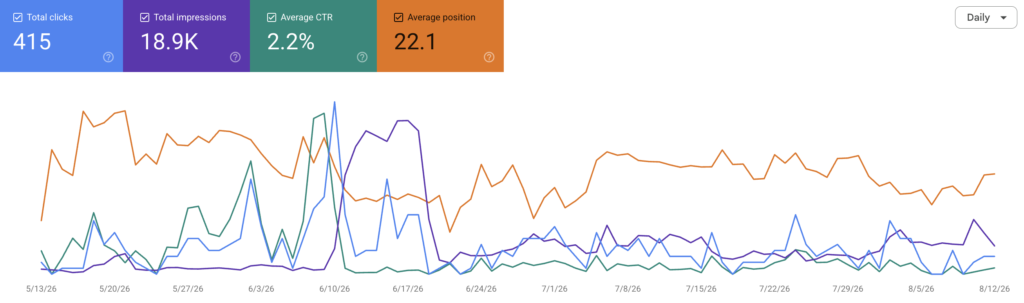
A real example, not a hypothetical one. In one lead generation campaign we ran, we tracked every lead from first contact through to final outcome, not just clicks. Out of 96 total leads generated, 31 converted to a confirmed result, a 32% lead-to-conversion rate. Nine more were still active in the pipeline (visited but undecided), and eight hadn’t been reached for a campus visit yet.
From Our Experience: That 32% number is the one that matters to a business owner, not how many people saw the ad or “showed interest.” Most small businesses stop measuring at “how many leads did we get.” Leads that go nowhere are just a more expensive version of doing nothing.
You don’t need an expensive dashboard for this. A simple spreadsheet with lead source, status, and outcome, updated weekly, beats an analytics tool nobody checks.
Weekly measurement checklist:
- Log every new lead with source, date, and status
- Update lead status weekly, not just at month-end
- Calculate cost per lead and cost per conversion, not just total spend
- Flag any channel with a conversion rate dropping two weeks in a row
- Review the full funnel monthly, not just top-of-funnel traffic
Pick a fixed day, Monday works, and actually look at it. Consistency matters more than the sophistication of the tool.
Key Takeaways
- Digital marketing for a small business means picking two or three channels that fit your budget and customer behavior, not running everything at once.
- Around 28% of local searches convert to a purchase within 24 hours, so delaying visibility has a same-day cost, not just a long-term one.
- Start with two questions: how fast you need revenue and whether your customer searches for you or needs to discover you first.
- SEO compounds but takes 3 to 6 months. Paid search and social ads work in days but stop the moment you stop paying.
- Budget roughly 7 to 8% of revenue if established, 12 to 20% if you’re new, and review the split every quarter.
- DIY suits more time than money. Hiring suits more money than time or a high cost of getting it wrong.
- Track leads all the way to the actual outcome. A lead that goes nowhere is just an expensive version of doing nothing.
FAQ:
Usually, yes, but only if you pick channels that match your budget and sales cycle. A mismatched channel, say SEO when you need revenue in 30 days, can make it look like digital marketing “doesn’t work” when really the timeline was wrong.
SEO, paid search and social ads (PPC), organic social media, email marketing, and content marketing. Most small businesses need two or three working together, not all five at once.
Budget around 7 to 8% of revenue if established, closer to 12 to 20% if new, per the SBA benchmark. Actual spend still varies by industry and channel mix, which is why a calculator beats a flat number.
Paid search brings traffic within days of launch. SEO usually takes 3 to 6 months before real movement, longer in competitive industries, while email marketing often shows results within weeks.
It depends on how fast you need results. Need revenue soon, start with paid search or social ads. Have more runway, organic channels cost less over time but take longer to build momentum.
DIY suits more time than budget, with room for early mistakes. Hiring suits businesses where getting it wrong would cost more than a retainer.
The commonly cited range is 7 to 8% for established small businesses, per SBA guidance, with newer businesses often needing 12 to 20%. From there, a 70/20/10 split helps decide where that budget actually goes.
Ready to stop guessing?
Everything above gets you to a decision. What it can’t do is run your numbers for you.
If you want a straight answer on where your budget should go, not a sales pitch, Book a free 20-minute marketing audit with our team. We’ll tell you, honestly, what’s working, what isn’t, and what to fix first.
Final Takeaway: Based on what we’ve seen across healthcare, education, and local service businesses, the biggest factor isn’t which channel you pick, it’s whether you fund one channel properly instead of three channels weakly. If you’re just starting out, match your channel to your sales cycle length first, then commit real budget to it for at least 90 days before judging the results.
About the Author:
I’m Yeshwanth Goud, and I run Spacekey Digital, an AI-powered growth and brand positioning firm based in Hyderabad. I work with healthcare, industrial, solar, education, and infrastructure brands, building the SEO, paid media, brand strategy, and automation systems behind their growth.
I focus on turning marketing from a cost center into a system that compounds—bringing in more qualified leads, strengthening category positioning, and reducing the manual work required to get results.